

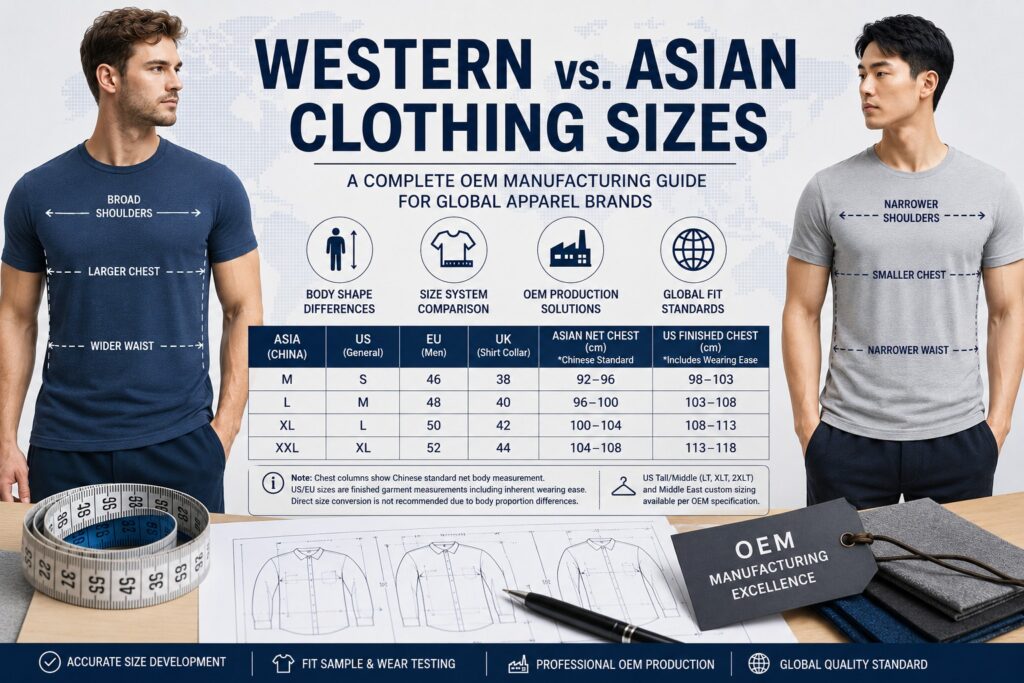
As global apparel supply chains become increasingly interconnected, numerous Western fashion brands source finished goods from Chinese OEM and ODM manufacturers to serve end consumers across North America, Europe, Australia and other global territories. Nevertheless, assuming universal garment sizing remains one of the most pervasive and cost-intensive pitfalls in apparel manufacturing: a men’s Large made to Chinese specs rarely matches a US Large, and a European Medium differs substantially from Korean or Japanese Medium equivalents.
(Last modified date: August 31, 2026)
Quick answer: Western and Asian clothing sizes are not interchangeable. Regional sizing systems are statistically derived from local anthropometric data, so a Chinese XL knit top typically aligns closer to a US M (slim fit) or US L (loose fit). Brands must develop market-specific size charts, use target-customer body data, and validate with pre-production fit samples instead of relying on crude conversion rules.
Key Takeaways
- Apparel sizing is not universal: it reflects national anthropometric surveys, fit aesthetics, and grading rules per market.
- Height, shoulder width, chest, waist, and hip proportions differ meaningfully between Western and Asian consumer populations.
- Asia uses letter sizing plus China’s GB/T height–chest format (e.g., 170/88A); the US adds Tall variants and larger tiers; Europe uses numeric chest-based grading (44–56).
- Blanket conversions like “Asian XL = US L” fail because body proportions, allowances, and fit expectations differ.
- Reliable OEM partners draft market-specific size charts, customize grading, and require pre-production fit trials before bulk release.
Understanding Body Shape Differences and Size Development for International Fashion Markets
For apparel brands expanding internationally, mastering these dimensional disparities is foundational to stable product quality, elevated customer satisfaction, reduced return rates and sustainable long-term brand development.
This industrial guide elaborates core morphological gaps between Western and Asian consumer demographics, decodes disparate global sizing regulatory frameworks, and delivers actionable factory implementation standards for brand partners cooperating with Chinese apparel OEM producers.
Why Clothing Sizes Are Not Universal
Unlike footwear, which has established globally harmonised measurement benchmarks in most mainstream economies, apparel sizing systems are statistically derived from regional anthropometric survey data of local resident populations.
Nation-specific sizing criteria are formulated based on aggregated regional statistics covering:
- Average standing height
- Bare chest circumference
- Natural waist girth
- Hip circumference
- Bi-acromial shoulder width
- Outer sleeve length
- Intersegmental bodily proportional ratios
- Locally prevailing consumer fit aesthetics
Apparel engineered for one geographic territory therefore requires targeted pattern modification before viable commercialisation in alternate regions. Within OEM production workflows, precise size grading and spec formulation carry equivalent priority alongside fabric sourcing, garment construction protocol and final QC inspection.
Key Physical Differences Between Western and Asian Consumers
1. Height Differences
Statistically, adult consumers from Northern Europe and North America record higher average standing heights compared to populations across East and Southeast Asia.
Average Adult Male Standing Height (20–29 age cohort, verified national anthropometric survey median data)
| Region | Average Height |
|---|---|
| Netherlands | 183 cm |
| Germany | 180 cm |
| United States | 175–176 cm |
| United Kingdom | 178 cm |
| China | 171–173 cm |
| Japan | 171 cm |
| South Korea | 174 cm |
Source note: figures follow the article’s original national survey data [VERIFY]. For cross-checking, NCD-RisC/Lancet 2020 reports 19-year-old male means of ~183.8 cm (Netherlands), ~176.9 cm (US), ~175.7 cm (China), ~171.9 cm (Japan), ~174.4 cm (South Korea).
These height differentials mandate dedicated pattern adjustments for Western-market production, including:
- Extended body torso length
- Elongated set-in sleeve length
- Increased trouser inseam dimension
- Elevated natural shoulder balance point positioning
2. Shoulder Width
Western demographic groups typically feature broader bi-acromial shoulder span, larger upper torso skeletal frames and enhanced pectoral musculature relative to average East Asian populations.
This specification gap proves critical during pattern development for:
- Polo knit shirts
- Woven formal dress shirts
- Outerwear jackets & blazers
- Corporate uniform tailoring
- Performance sportswear
Neglecting shoulder dimension revisions triggers constrained arm mobility and poor upper-body fit, even when chest circumference specs align correctly with target sizing.
3. Chest and Upper Body Proportions
Western male populations commonly exhibit expanded bare chest girth, higher average lean muscle mass and wider ribcage skeletal construction; conventional East Asian sizing frameworks are benchmarked around comparatively compact upper-torso anatomical measurements.
OEM grading operations must build independent size run specs for Western chest scaling rather than applying uniform proportional upscaling derived from domestic Asian base patterns.
4. Waist and Hip Proportions
Regional bodily fat distribution patterns create measurable waist and hip dimensional divergence.
Western consumers generally present larger natural waist circumference, broader hip girth and wider within-population size variance. While consumers in China, Japan and South Korea predominantly favour slim-fit, tailored silhouettes, Southeast Asian and South Asian buyers regularly prioritise relaxed, roomy cuts. Consequently, apparel graded for Northeast Asian slim-fit aesthetics typically runs tight across waist and hip when merchandised within European or North American retail channels.
Differences in Clothing Size Systems
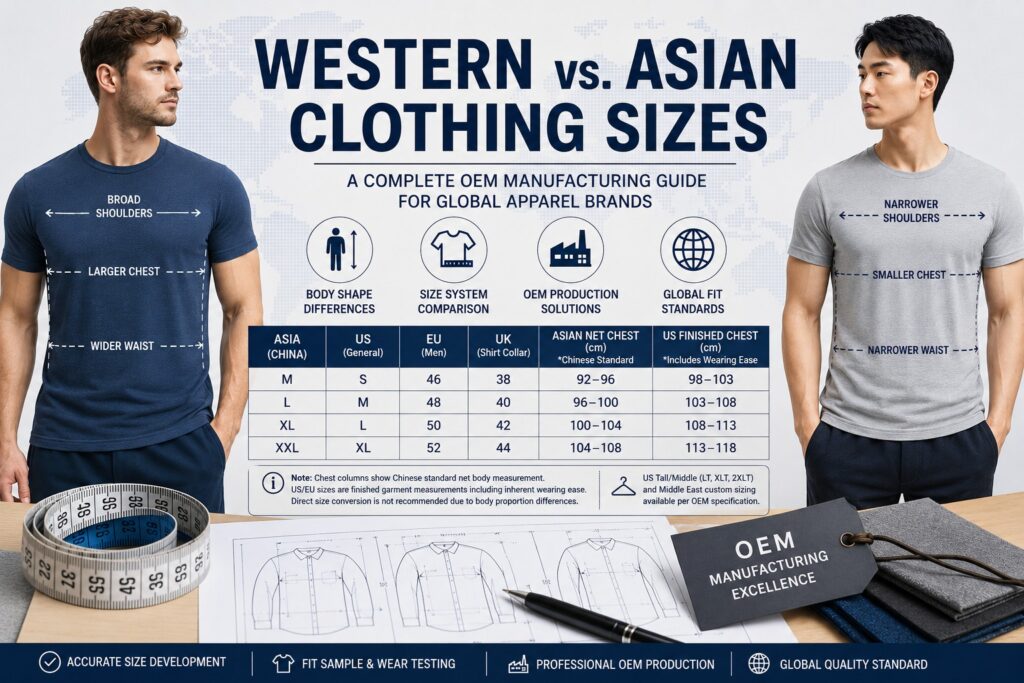
Asian Size Systems
Northeast Asian apparel employs dual sizing notation: alphabetical sizing (XS/S/M/L/XL/XXL) alongside China’s national GB/T numerical height–chest classification format such as 165/84A, 170/88A, 175/92A, 180/96A.
Format definition: The first three digits denote target wearer nominal height in centimetres; subsequent two digits reference wearer’s bare net chest circumference in centimetres; trailing alphabetical character signifies body-type classification (Y=lean build, A=standard regular build, B=slightly stout build, C=heavy full build per Chinese national sizing standard GB/T 1335).
US Size System
The US apparel industry utilises lettered sizing ranging XS through S/M/L/XL/XXL plus extended big-and-tall tiers (3XL,4XL,5XL). Critical regional nuance: North American mainstream sizing additionally includes dedicated Tall/T variant specs for above-average height consumers, featuring lengthened torso and sleeve dimensions. Every alphabetical tier’s finished garment measurements sit materially larger than corresponding Asian letter sizing equivalents.
Reference benchmark: An Asian XL knit top typically aligns with US M for slim-cut apparel and US L for loose-fit outerwear; no fixed one-to-one conversion applies across all product categories.
European Size System
Continental European men’s tailored apparel relies on numerical chest-based sizing grading: 44,46,48,50,52,54,56, calculated against wearer bare chest circumference with fixed incremental progression per standard EU tailoring norms. These numeric codes originate from net body measurements rather than simplified letter classification conventions.
Why Direct Size Conversion Often Fails
Many import purchasers erroneously adopt blanket cross-market conversion rules such as Asian XL = US L or Asian XXL = EU XL, which consistently generates costly fit defects for four core reasons:
- Fundamental inter-regional bodily proportional divergence across torso, limbs and skeletal structure
- Non-equivalent native shoulder width benchmarks
- Varied standard sleeve and body length allowances
- Contrasting regional consumer fit expectation (slim vs relaxed aesthetic requirements)
A garment may fit perfectly across chest circumference yet run excessively short in overall length or constrictive across shoulders via crude size conversion. Market-leading apparel brands develop standalone region-specific spec charts instead of generic cross-size conversion tables.
How Professional OEM Manufacturers Solve Size Differences
1. Develop Market-Specific Size Charts
Qualified export-focused OEM factories never apply domestic Chinese retail sizing specifications to export bulk orders. Instead, independent graded size specification documents are drafted individually for core target territories: USA, Canada, Australia, UK, Germany, France, Scandinavia and Middle Eastern markets. Middle Eastern sizing requires standalone waist-enlarged grading adjustments due to regional higher average abdominal girth despite near-European height metrics.
2. Use Target Customer Body Data
Premium global apparel brands finalise garment patterns anchored to proprietary anthropometric datasets sampled directly from their core end-consumer demographic. Key measured parameters for spec development include: standing height, bare chest, natural waist, full hip, neck base circumference, finished outer sleeve length and bi-acromial shoulder width; these datasets form the mathematical foundation of accurate size grading rules.
3. Produce Pre-Production Fit Samples Prior to Mass Manufacturing
Pre-production fit sampling constitutes an irreplaceable quality checkpoint within OEM development workflows. Before full bulk release, brands execute live wear trials with test subjects matching target-market average body statistics to validate: overall body ease, sleeve hang positioning, shoulder balance alignment, finished garment length and unrestricted wear mobility. This stage eliminates bulk-scale financial losses stemming from systemic sizing errors.
4. Adjust Grading Rules for Different Markets
Apparel grading is not uniform omnidirectional pattern scaling. Expert pattern technicians customise incremental grading values per regional anatomical traits across five core parameters: chest circumference step increments, shoulder span incremental growth, sleeve lengthening ratios, vertical body length progression and neck circumference scaling. Differentiated grading ensures consistent natural fit across the full ordered size run for each export destination, accounting for varied fabric stretch properties and pre-defined finished ease allowances between Asian and Western patterns.
Key industry distinction: Grading splits into net body measurement scaling and finished garment ease allowance setup; Western casual apparel routinely carries substantially higher built-in wearing ease than standard Northeast Asian tailored apparel.
OEM Procurement Recommendations for Western Apparel Brands Sourcing in China
Brands contracting Chinese OEM production must furnish suppliers with four complete document sets to guarantee sizing precision:
1. Comprehensive Tech Packs
Containing granular finished measurement specs, full construction schematic details, defined stitching standards and complete fabric composition & shrinkage pre-test documentation.
2. Customised Target-Market Size Charts
Documenting both wearer net body dimensions and finished garment measurements alongside agreed dimensional tolerance thresholds per size tier.
3. Defined Fit Guidance Notes
Explicit written classification of required cut style: Slim Fit, Regular Classic Fit, Relaxed Casual Fit, Athletic Muscular Fit and Oversized Streetwear Fit with quantifiable ease benchmarks for each variant.
4. Physical Reference Sample Garments
Where feasible, original approved reference samples from target-market existing inventory drastically reduce interpretive deviation during pattern replication by OEM pattern departments.
Common Costly Sizing Mistakes Brands Must Avoid
1. Repurposing Domestic Chinese Sizing Specs for Export Merchandise
The top driver of post-sale customer complaints and cross-border product returns for China-sourced apparel.
2. Solely Benchmarking Specs Using Chest Circumference While Neglecting Shoulder Calibration
Correct chest measurements cannot compensate for ill-fitting narrow or over-wide shoulder construction.
3. Skipping Pre-Production Live Wear Testing
Static flat-pattern lab measurements cannot fully replicate dynamic in-motion real-world garment fit performance.
4. Deploying a Single Global Size Chart Across All Geographic Sales Zones
A size specification optimised for North American consumers consistently delivers substandard fit for Japanese or Southeast Asian retail markets.
The Future of Global Apparel Sizing
The global apparel sector is steadily transitioning toward data-centric sizing R&D driven by evolving industrial technology:
- 3D whole-body anthropometric scanning (TC² industrial scanners prevalent among Western DTC brands; domestic Chinese OEMs adopt Richpeace 3D sampling platforms)
- AI-powered automated pattern grading and modification algorithms
- Cloud-based digital virtual fitting simulation systems
- Centralised regional consumer body-shape big-data repositories
These technical advancements enable OEM factories and brand operators to engineer dimensionally precise garments, minimise retail return ratios and elevate end-customer satisfaction long-term. Sizing specification management has evolved from a minor technical detail into a core strategic pillar governing finished product quality, consumer shopping experience and long-term brand market reputation.
Conclusion
Deep comprehension of Western–Asian anthropometric variance remains indispensable for profitable cross-border apparel OEM production and international market penetration. While Asian and Western sizing utilise identical alphabetical labelling nomenclature on garment tags, measurable gaps persist across average height, shoulder skeletal width, upper torso structure, waist-hip bodily morphology and locally preferred fit aesthetics.
Brands partnering with experienced Chinese OEM production houses mitigate sizing-related risks through custom regional spec drafting, professionally differentiated size grading protocols and mandatory pre-production fit validation. Industry-leading apparel operators avoid crude cross-size conversion and instead build garment patterns engineered around the anatomical characteristics of their target end-consumer base.
Combining validated regional anthropometric statistics, master-level pattern-making expertise and rigorous tiered OEM quality control protocols enables brands to deliver consistent superior fit performance, cut global return expenditure and build lasting end-consumer loyalty across diversified international sales territories.
FAQs
Q1: Why are standard Asian clothing labelled sizes generally smaller than equivalent Western letter sizing?
A: Asian domestic sizing standards are statistically formulated on regional national anthropometric census data, whose aggregated average population body dimensions trend lower than corresponding North American and European baseline measurements.
Q2: Are Chinese OEM manufacturers capable of accurate Western-size compliant production?
A: Yes. Seasoned export-focused Chinese OEM facilities routinely produce apparel aligned with US, EU, Australian and other international sizing benchmarks when clients submit complete, detailed target-market technical specifications and approved size grading charts.
Q3: What is the most robust method to guarantee sizing accuracy within OEM bulk production?
A: Formulate territory-exclusive custom size specification charts, submit fully detailed technical packs to manufacturers, complete pre-production fit sample validation and execute real-subject wear trials before authorising full bulk manufacturing release.
Q4: Does a single universal global apparel sizing standard currently exist worldwide?
A: No. Apparel sizing frameworks differ considerably between sovereign nations, individual retail brands and targeted end-consumer demographic groups; cross-category (knit vs woven vs outerwear) sizing rules also diverge significantly.
Q5: What core value does pre-bulk fit testing deliver for brand operators?
A: Live fit trials verify real-world wearing comfort and dimensional compliance on representative end consumers, mitigating large-scale financial losses caused by post-production sizing non-conformity, excessive retail returns and negative consumer brand feedback.
Related Articles
- China vs. Southeast Asia Apparel Manufacturing: Which Is Better for Your Brand?
- How Clothing Factories Control Shrinkage, Color Variation, and Size Inconsistency
- Chinese Clothing Manufacturers Wholesale: Your Complete Guide to Reliable Bulk Apparel Suppliers
- What Should a Pre-Production Approval Checklist for Apparel Include?
- Low-MOQ Global Clothing Manufacturer: Scale Your Apparel Brand Effortlessly
Official Resources
- GB/T 1335.1-2008: Standard sizing systems for garments – Men (China national standard, official platform)
- NCD Risk Factor Collaboration: Height data downloads (Lancet 2020)
References
- NCD Risk Factor Collaboration: “Height and body-mass index trajectories of school-aged children and adolescents from 1985 to 2019 in 200 countries and territories,” The Lancet 2020; 396:1511-1524 – ncdrisc.org
- GB/T 1335.1-2008, Standard sizing systems for garments – Men – openstd.samr.gov.cn
- Epic Sourcing: “Asian Size Chart Conversion Guide for Importers (2026)” – epicsourcing.co
- Cleveland Clinic: “The Average Height for Men and What It Means for Men’s Health” – health.clevelandclinic.org