Private label clothing packaging must protect the garment, communicate the brand and meet the requirements of the channel through which it will be sold. Retail stores, direct-to-consumer websites and Amazon FBA may sell the same T-shirt, but they do not necessarily need the same packaging.
A premium box may improve an influencer unboxing experience but add unnecessary volume to an Amazon shipment. A transparent polybag may help a warehouse identify products quickly but offer little differentiation on a retail shelf. A beautiful package can still fail operationally if its barcode cannot be scanned or the wrong size label is attached.
At LSLONG, packaging discussions usually begin before bulk production—not after the garments have been sewn. Labels, folding dimensions, barcode placement, carton quantities and sales-channel requirements all affect how the final order should be prepared.
This guide explains how apparel brands, retailers and Amazon sellers can build a packaging system that looks professional, controls cost and moves efficiently from a Shenzhen clothing factory to the final customer.
What Does Private Label Clothing Packaging Include?
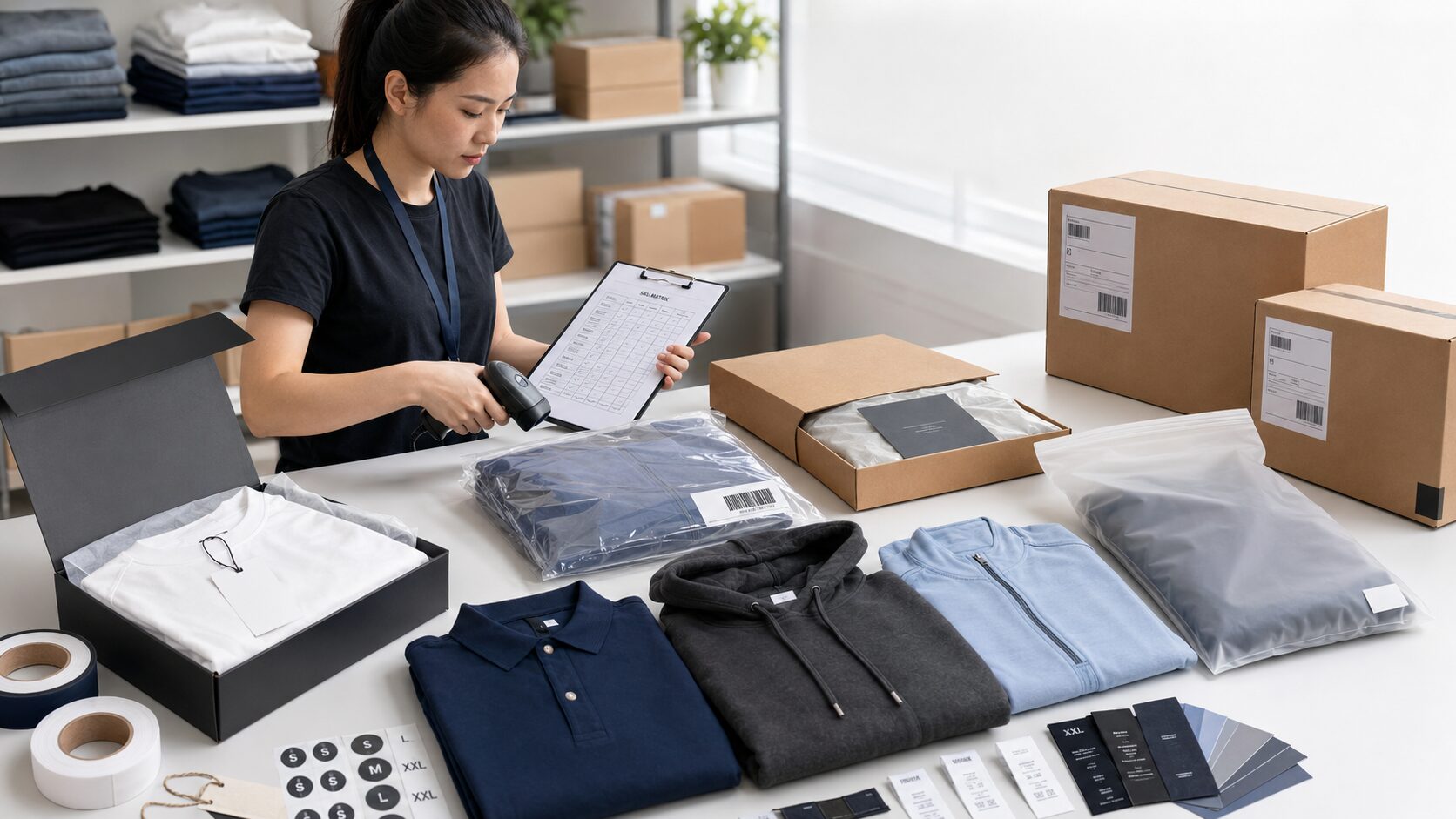
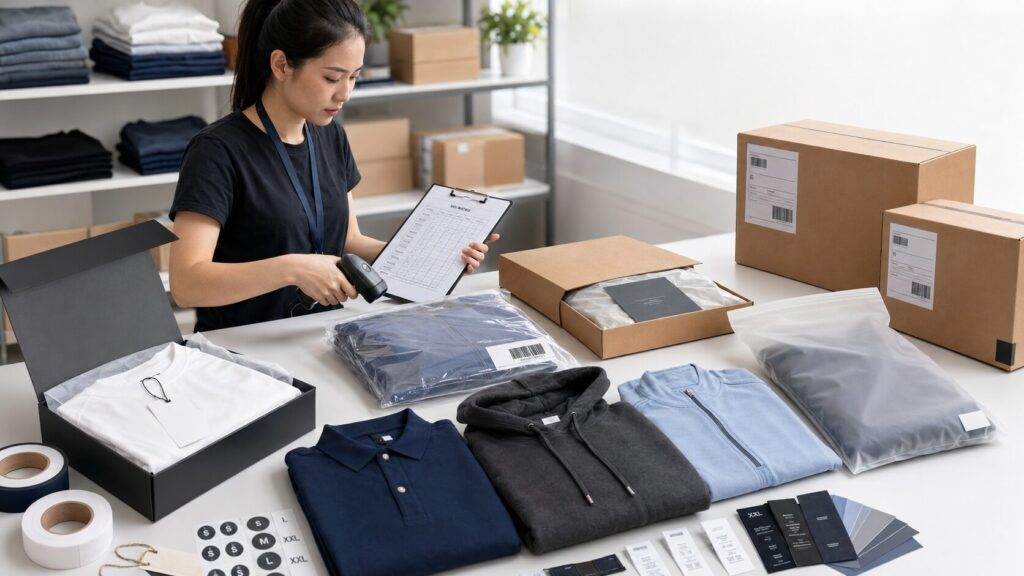
Private label clothing packaging is not one item. It is a coordinated system containing several layers.
| Packaging Layer | Primary Function | Common Components |
|---|---|---|
| Garment identification | Identifies product and provides required information | Neck label, size label, care label and country-of-origin label |
| Individual unit packaging | Protects and identifies one sellable unit | Polybag, paper sleeve, zipper bag, envelope or product box |
| Brand presentation | Communicates brand identity | Hang tag, sticker, tissue paper, thank-you card and custom print |
| Warehouse identification | Connects the physical item to inventory data | SKU, UPC, EAN, FNSKU and barcode label |
| Shipping packaging | Protects multiple units in transit | Inner carton, export carton, carton label and packing list |
| Customer delivery packaging | Delivers an online order | Mailer, shipping box, tape and protective inserts |
A reliable packaging specification defines each layer separately. Simply writing “custom packaging” on a purchase order leaves too much room for interpretation.
The Three Jobs Every Apparel Package Must Perform
Good clothing packaging performs three jobs at the same time.
1. Protect the product
The garment must remain clean, dry and presentable during:
- Factory storage
- International transportation
- Customs inspection
- Warehouse handling
- Fulfillment
- Last-mile delivery
- Customer returns
Packaging should prevent dust, moisture exposure, dye transfer, snagging and excessive wrinkling without creating unnecessary bulk.
2. Identify the correct SKU
A warehouse operator must be able to distinguish between products that may look almost identical.
For example:
- Black T-shirt, size M
- Black T-shirt, size L
- Navy T-shirt, size M
- Black oversized T-shirt, size M
- Black women’s fitted T-shirt, size M
The style name alone is not enough. Each sellable variation needs a controlled SKU and the correct corresponding barcode.
3. Represent the brand
Packaging is often the first physical brand experience after purchase.
It can communicate:
- Market positioning
- Product value
- Sustainability strategy
- Care information
- Brand story
- Social media details
- Customer support
- Reorder instructions
The right level of presentation depends on the channel and product price. Premium packaging should feel intentional, not excessive.
Retail, E-Commerce and Amazon FBA Need Different Packaging Strategies
Retail Packaging
Physical retail packaging must support merchandising, stock handling and customer inspection.
Depending on the product, buyers may need:
- Branded hang tags
- Size stickers
- Price tickets
- Hangers
- Belly bands
- Fold boards
- Shelf-ready boxes
- Security-tag positioning
- Store-specific barcodes
- Carton assortments by store
Retail packaging must remain attractive after repeated handling. Customers may unfold a garment, compare sizes and return it to the shelf several times.
Retail questions to answer
- Will the garment hang or sit folded on a shelf?
- Can the size be identified without opening the package?
- Will the retailer apply its own price label?
- Does each store need a separate assortment?
- Is the package designed for individual sale or multipacks?
- Are there restrictions on plastic packaging?
- Must the carton be shelf-ready?
For wholesale programs, packaging instructions may differ by retailer. A brand selling to several chains should avoid assuming that one retailer’s ticketing format will work for another.
Direct-to-Consumer E-Commerce Packaging
For a brand’s own website, packaging becomes part of the customer experience.
The package should photograph well, open cleanly and protect the garment without making returns difficult.
Common options include:
- Recyclable paper mailers
- Reusable zipper bags
- Compostable-style mailers where suitable
- Custom tissue paper
- Branded stickers
- Thank-you cards
- Product-care cards
- Return instructions
- QR codes
- Lightweight shipping boxes
The challenge is balancing presentation with fulfillment efficiency.
A rigid gift box can create a premium impression, but it also increases:
- Packaging cost
- Storage space
- Carton volume
- Freight cost
- Fulfillment handling
- Material consumption
For many mid-priced apparel brands, a well-designed mailer, clean folding, tissue paper and a quality branded card produce a better cost-to-experience balance than a large box.
Amazon FBA Apparel Packaging
Amazon FBA packaging is primarily an inventory and fulfillment system. Brand presentation remains useful, but warehouse readiness comes first.
Each unit should arrive as a clearly identifiable, sellable item that can move through receiving and fulfillment without additional preparation.
Amazon currently requires sellable units to have an exterior scannable barcode or label. When an Amazon barcode is used, it must correspond to the correct unique product. Other exposed barcodes may need to be covered to prevent the wrong code from being scanned. Sellers should confirm the latest rules for their marketplace in Amazon’s official product packaging requirements before approving bulk packaging.
Practical FBA apparel packaging checklist
For most individually packed garments, verify that:
- The product is completely contained
- The package remains closed during handling
- The garment cannot fall out
- The exterior barcode is visible
- The barcode is flat and scannable
- The barcode matches the exact size and color
- Unwanted barcodes are covered
- Required warnings are present
- The package does not contain loose hangers or sharp components
- Multipacks are clearly identified as one sellable unit
- The package is ready for fulfillment without factory-center rework
Marketplace requirements can change. Sellers should download the current label and preparation instructions from their own Seller Central account before the factory begins mass printing.
Product Labels and Packaging Labels Are Not the Same
Apparel projects frequently confuse garment labels with logistics labels.
Garment labels
These remain attached to the product and may include:
- Brand name
- Size
- Fiber composition
- Care instructions
- Country of origin
- Product identification
- Importer or responsible-party information
The required wording depends on the destination market. Buyers remain responsible for confirming applicable labeling regulations.
Packaging labels
These are attached to the bag, box or carton and may include:
- Internal SKU
- Product name
- Color
- Size
- Quantity
- UPC
- EAN
- FNSKU
- Carton number
- Destination
- Purchase order number
One label should not automatically be expected to perform both functions.
A scannable FNSKU on a polybag does not replace a legally required garment care label. Likewise, a garment’s internal size label does not provide enough information for automated warehouse receiving.
Common Individual Packaging Options
Standard Transparent Polybag
A transparent polybag is widely used because it is lightweight, economical and easy for warehouses to inspect.
Best suited to:
- Bulk wholesale orders
- Amazon FBA apparel
- Distributor shipments
- Stockroom handling
- Cost-sensitive programs
Advantages:
- Low unit cost
- Minimal weight
- Product visibility
- Easy barcode application
- Efficient carton packing
Limitations:
- Limited premium presentation
- Plastic-reduction concerns
- Warning requirements may apply
- Thin materials may tear
- Excessively large bags increase movement and wrinkles
The bag should fit the folded garment closely enough to remain tidy without compressing the product.
Frosted or Printed Polybag
A frosted bag creates a more refined private label appearance while retaining many of the operational advantages of a standard polybag.
It can include:
- Brand logo
- Slogan
- Website
- Social media information
- Care message
- Recycling instructions
Before printing, leave a controlled area for the SKU or marketplace barcode. Printing decorative artwork first and adding a barcode later can result in poor contrast or an inconvenient label position.
Reusable Zipper Bag
Zipper bags work well for sportswear, swimwear, travel apparel, premium basics and products likely to be stored between uses.
Advantages:
- Reusable
- Strong presentation
- Easy product access
- Suitable for returns
- Higher perceived value
Limitations:
- Higher cost
- Greater material weight
- More storage volume
- May be excessive for low-priced products
The bag’s value should match the product’s retail position.
Paper Sleeve or Belly Band
A paper sleeve can hold a folded garment together while leaving part of the product visible.
Suitable for:
- Retail shelves
- Eco-positioned basics
- Socks and accessories
- Folded T-shirts
- Gift sets
Paper packaging may reduce visible plastic but offers less protection from moisture. It may still require an outer shipping layer for e-commerce or international transportation.
Kraft Envelope
A kraft envelope creates a natural, minimal presentation for light garments.
Suitable for:
- T-shirts
- Underwear
- Lightweight children’s apparel
- Direct-to-consumer products
Its performance depends on paper strength, closure design and transport conditions. A paper envelope that tears during fulfillment is not more sustainable in practice if the garment must be repacked.
Custom Product Box
Boxes are appropriate when the packaging is part of the product’s value proposition.
Common applications include:
- Premium T-shirts
- Gift sets
- Corporate apparel
- Influencer packages
- Subscription boxes
- High-end private label collections
Before selecting a box, calculate its effect on carton utilization and dimensional weight.
A package that is only 20 millimetres deeper may significantly reduce the number of units that fit into an export carton.
Garment Folding Is Part of the Packaging Specification
“Fold normally” is not an adequate manufacturing instruction.
The buyer should confirm:
- Finished folded width
- Finished folded height
- Direction of the front graphic
- Sleeve position
- Collar presentation
- Use of tissue or fold board
- Hang-tag position
- Barcode orientation
- Bag opening direction
The folding method affects both presentation and carton efficiency.
For graphic T-shirts, the design may need to be visible through a transparent bag. For embroidered polos, the fold should avoid creating pressure directly on the embroidery.
A master folding sample should be approved before bulk packing begins.
How to Build a Reliable SKU and Barcode System
Packaging errors are often data errors rather than printing errors.
A factory may apply the barcode file exactly as received, but the label will still be wrong if the buyer’s SKU mapping is incorrect.
Create a master packaging matrix containing:
| Field | Example |
|---|---|
| Style number | TS-104 |
| Product name | Men’s Premium Crew Neck T-Shirt |
| Color | Navy |
| Color code | NVY |
| Size | Large |
| Size code | L |
| Internal SKU | TS-104-NVY-L |
| UPC/EAN | Buyer-provided code |
| FNSKU | Seller Central-generated code |
| Packing method | Frosted bag |
| Units per carton | 40 |
| Carton assortment | Solid SKU |
Every size and color combination should occupy a separate row.
Do not generate final FNSKU labels too early
Amazon identifiers should be supplied after the listing structure and fulfillment method are confirmed. If the seller changes the listing, SKU relationship or barcode preference, previously printed packaging may become unusable.
A safer process is:
- Finalize product variations
- Create listings
- Confirm fulfillment settings
- Generate barcode files
- Match every file to the packaging matrix
- Print a small test batch
- Scan and verify
- Approve bulk printing
Barcode Printing and Placement
A barcode can look correct but fail during warehouse scanning.
Common causes include:
- Low print contrast
- Blurred lines
- Insufficient quiet space
- Wrinkled label application
- Placement over a bag seam
- Placement on a curved surface
- Transparent label over patterned packaging
- Barcode covered by tape
- Wrong label applied to the correct product
- Correct label applied to the wrong size
Barcode labels should be applied to a flat exterior surface. Amazon publishes specific requirements for Amazon barcodes, including clear space around the barcode and associated text; sellers should verify the current specifications in the official Amazon barcode guidance.
The factory should scan production labels during packaging rather than relying only on visual inspection.
Multipack and Bundle Packaging
A multipack must be physically and operationally treated as one sellable unit.
Examples include:
- Three T-shirts in different colors
- Two school polo shirts
- A hoodie and sweatpants set
- Five pairs of socks
- A sports uniform kit
The outer package should contain all components securely. Component-level barcodes may need to be covered when only the bundle is intended for sale.
The packaging specification should clearly state:
- Number of items per set
- Product combination
- Size combination
- Outer barcode
- Internal barcode treatment
- Folding order
- Set identification
- Whether individual components may be sold separately
A packaging line should not be expected to infer these rules from product names.
Retail-Ready Carton Planning
The export carton is where product packaging meets logistics.
A carton specification should define:
- Carton material
- External dimensions
- Maximum gross weight
- Units per carton
- Solid or mixed SKU
- Carton numbering
- Shipping marks
- Purchase order reference
- Destination
- Barcode requirements
- Pallet requirements where applicable
Amazon’s current shipping guidance requires appropriate rigid shipping boxes with intact flaps, together with the applicable shipment and box identification labels. Sellers should follow the labels generated for the actual shipment plan and confirm the current FBA shipping and routing requirements.
Solid-SKU cartons
A solid carton contains one style, color and size.
Advantages:
- Easier receiving
- Lower picking risk
- Simpler inventory reconciliation
- Suitable for large quantities
Assorted cartons
An assorted carton contains a predefined size or color ratio.
Advantages:
- Useful for store allocation
- Reduces destination repacking
- Supports campus or branch distribution
However, assorted cartons require more careful packing and inspection. The exact assortment should be printed on the carton label and included in the packing list.
How Packaging Influences Landed Cost
The price of a packaging item is only one part of its real cost.
A useful formula is:
Packaging Cost per Sold Unit = Packaging Materials + Application Labor + Labeling + Carton Allocation + Freight Impact + Prep or Rework Risk
For e-commerce, also consider:
- Fulfillment fees
- Storage volume
- Dimensional weight
- Return packaging
- Damage rate
- Disposal cost
A low-cost package that frequently tears may create higher warehouse preparation and customer-service costs. A beautiful oversized box may increase freight and storage costs far beyond its purchase price.
Compare packaging by packed dimensions
Ask the factory to provide:
- Individual packaged dimensions
- Individual gross weight
- Units per export carton
- Carton dimensions
- Carton net weight
- Carton gross weight
- Total cartons
- Total shipment volume
These figures allow buyers to evaluate freight before approving bulk production.
Sustainable Apparel Packaging Without Greenwashing
Sustainable packaging should be evaluated as a complete system rather than through one material claim.
Questions to ask include:
- Is the package necessary?
- Can the material quantity be reduced?
- Is the package recyclable in the destination market?
- Does it contain mixed materials that are difficult to separate?
- Can the customer reuse it?
- Does it protect the product adequately?
- Will it increase shipping volume?
- Is the environmental claim supported by documentation?
Replacing a durable lightweight polybag with a much heavier package does not automatically reduce total environmental impact.
Brands should also avoid vague statements such as “100% eco-friendly.” More specific language is usually more credible, provided it can be substantiated.
Examples include:
- “Made with recycled-content plastic”
- “Paper sourced from certified suppliers”
- “Designed for reuse”
- “Please check local recycling instructions”
The exact statement should reflect the material and documentation actually used.
Quality Control for Private Label Packaging
Packaging should be included in the inspection plan, not treated as a final decoration step.
Incoming packaging inspection
Check:
- Color
- Dimensions
- Material thickness
- Print position
- Print clarity
- Closure strength
- Odor
- Surface damage
- Quantity
Packaging-line inspection
Check:
- Correct garment
- Correct size
- Correct color
- Correct label
- Correct barcode
- Correct folding
- Correct accessories
- Cleanliness
- Package closure
Finished-unit inspection
Check:
- Barcode scan
- Appearance
- Seal integrity
- Hang-tag position
- Warning placement
- Product visibility
- Carton assortment
- Shipping marks
The most damaging packaging error is usually not a slightly imperfect logo print. It is a systematic SKU mismatch repeated across an entire production run.
A Better Packaging Approval Workflow
A practical OEM packaging process follows these steps.
Step 1: Confirm the sales channel
Identify whether the products are intended for:
- Physical retail
- The brand’s own website
- Amazon FBA
- Other marketplaces
- Wholesale distribution
- Subscription boxes
- Corporate or school programs
Step 2: Build the packaging bill of materials
List every component:
- Garment labels
- Hang tags
- Strings
- Stickers
- Inserts
- Tissue paper
- Individual bag
- Product box
- Barcode label
- Carton
- Carton label
- Tape
Step 3: Confirm artwork and legal information
Separate brand artwork from regulated garment information. Confirm spelling, color, dimensions and placement.
Step 4: Prepare the SKU matrix
Connect each product variation to its exact labels and packing instructions.
Step 5: Produce packaging samples
Review the complete packed product—not only a flat artwork proof.
Step 6: Conduct a packing trial
Pack several units and confirm:
- Folding speed
- Appearance
- Bag fit
- Barcode readability
- Carton utilization
- Packed dimensions
- Product protection
Step 7: Approve the master packed sample
Keep one approved unit as the production reference.
Step 8: Inspect bulk packaging
Use barcode scanning and sampling throughout production.
What LSLONG Needs to Prepare Your Packaging Proposal
For an accurate OEM quotation, provide:
- Product list
- Order quantity
- Size and color breakdown
- Sales channels
- Destination markets
- Garment label artwork
- Hang-tag artwork
- Barcode files
- Packaging dimensions
- Bag or box material
- Print colors
- Inserts
- Carton assortment
- Shipping method
- Fulfillment requirements
- Target delivery date
If the packaging has not yet been designed, explain the brand positioning, retail price, fulfillment method and customer experience you want to create.
Why Work With LSLONG for Private Label Clothing Packaging?
Shenzhen LSLONG Garments provides OEM and ODM clothing manufacturing for T-shirts, polo shirts, hoodies, sportswear, school uniforms and other custom apparel programs.
Packaging services can be integrated into the manufacturing workflow, including:
- Custom neck labels
- Size labels
- Care labels
- Heat-transfer labels
- Woven labels
- Hang tags
- Product stickers
- Individual garment bags
- Branded packaging
- Barcode application
- E-commerce packaging
- Export cartons
- Assorted packing
- Retail-ready preparation
Integrating packaging at the factory helps reduce downstream handling. Garments can be folded, labeled, packed and sorted according to the buyer’s approved specification before export.
For Amazon projects, LSLONG can apply buyer-supplied SKU and barcode files according to the confirmed packing matrix. The seller should provide current marketplace requirements and final labels from the relevant Amazon account.
Final Thoughts: Packaging Is Part of the Product
Private label clothing packaging is not merely what surrounds the garment. It connects design, manufacturing, inventory, fulfillment and customer experience.
A strong packaging system answers four questions:
- Is the garment protected?
- Can the SKU be identified without error?
- Does the packaging suit the sales channel?
- Does it represent the brand at an appropriate cost?
Retail packaging should support merchandising. Direct-to-consumer packaging should create a clean, memorable delivery experience. Amazon FBA packaging should prioritize containment, barcode accuracy and fulfillment readiness.
The most effective solution is often not the most expensive one. It is the package that performs reliably from the LSLONG production line in Shenzhen to the moment the customer opens it.
If you are developing a private label apparel collection, send LSLONG your product specifications, sales channel, packaging artwork and fulfillment requirements.
Our OEM team can help turn these inputs into a clear packaging bill of materials, packed sample and bulk production standard.
Contact LSLONG for Custom Apparel Manufacturing and Private Label Packaging Solutions.
Frequently Asked Questions
What packaging is best for private label clothing?
The best packaging depends on the product, sales channel, brand position and logistics model. Polybags are efficient for wholesale and fulfillment, while printed bags, paper sleeves and boxes offer stronger brand presentation.
Can LSLONG add custom labels and packaging to garments?
Yes. LSLONG can support neck labels, care labels, size labels, hang tags, branded bags, barcode labels and export cartons according to the approved OEM specification.
Does Amazon FBA require apparel to be individually packaged?
Apparel generally needs to arrive as a secure, identifiable sellable unit. Sellers should verify the current packaging and preparation requirements for their product and marketplace in Seller Central before production.
Where should the FNSKU label be placed?
It should be visible and scannable on the exterior of the sellable unit, applied to a flat surface and matched to the exact product variation. Other exposed barcodes may need to be covered.
Can a factory create FNSKU labels?
The factory can print and apply the files supplied by the seller. The seller should create the listing and generate the correct label files from the relevant Seller Central account.
Should each size and color have a different barcode?
Yes. Each sellable variation should have its own controlled SKU and corresponding barcode where required.
Are custom clothing boxes suitable for Amazon FBA?
They can be, provided they meet current packaging, barcode and fulfillment requirements. Buyers should also consider the effect of box dimensions on storage and fulfillment costs.
How can packaging costs be reduced?
Use efficient dimensions, limit unnecessary components, standardize packaging across styles, choose appropriate materials and optimize the number of units per carton.
What information belongs on a clothing care label?
Requirements vary by destination but may include fiber composition, care instructions, country of origin and responsible-party information. Buyers should confirm the regulations for each target market.
When should packaging be approved?
Packaging should be approved before bulk garment production is completed. Labels, barcode files and packaging materials need sufficient time for sampling, verification and mass production.
Author Profile

-
LISLON is a leading China OEM clothing manufacturer based in Shenzhen, Guangdong, the core of China’s garment industry. Founded in 1999, we specialize in custom polo shirts, T-shirts, sportswear, corporate uniforms, and hoodies with flexible OEM/ODM services.
Trusted by global brands like Mercedes-Benz, BYD, China Mobile, and PetroChina, LISLON delivers reliable, high-quality bulk apparel manufacturing. Contact us for expert support on your custom clothing production.
Latest entries
 Knowledge2026-07-17How Clothing Factories Control Shrinkage, Color Variation and Size Inconsistency
- Apparel Brand Business2026-07-16Private Label Clothing Packaging Guide for Retail, E-Commerce and Amazon FBA
- School Uniforms2026-07-152027 School Uniform Sourcing Timeline: When Should Schools and Distributors Place OEM Orders?
- Apparel OEM2026-07-14Custom T-Shirt Manufacturing Cost Breakdown: What Determines Your Factory Price?