

T-shirt neckline construction is the first thing a customer notices about a garment and the first component to fail. A neckline that waves, stretches or loses its shape makes an otherwise sound shirt look worn out, and the failure appears after washing rather than at delivery. The band, its stretch and recovery, the tape behind the seam and the stitch route together decide whether the opening holds, which is why the neckline belongs in the specification rather than in the sample room’s judgement.
What Does the Neckline Decision Change Downstream?
It sets shape retention, comfort and decoration space.
The neckline decides how the opening holds after repeated washing, how the shirt sits at the collarbone and how much of the front panel is available for decoration.
Shape retention is the primary consequence. The band has to be able to stretch over the head and return, which means it needs more elasticity than the body cloth, and it has to keep that elasticity after laundering. A band with insufficient recovery grows, the opening widens and the shirt reads as worn out while the body is still sound. Comfort follows: a band that is too tight pulls at the neck in wear, and one that is too loose lets the opening drop, which also changes where a chest print sits.
Decoration is the commercial consequence. A wider neckline leaves less room for a chest mark and moves its position closer to the shoulder, while a narrow band with a higher opening gives a taller front panel. For programmes that print or embroider close to the neck, the neckline specification and the decoration placement have to be agreed together, because a change to the opening changes the space available.
Rib, Folded and Self-Fabric Bands: How They Differ
Three band constructions dominate t-shirt production, and each behaves differently. A rib band is knitted with a structure that gives it natural elasticity, which suits openings that have to stretch repeatedly. A folded band uses a double layer of self-fabric, which holds shape through thickness rather than through stretch and gives a cleaner, more tailored appearance. A self-fabric band with a single layer is the lightest option and relies on the cloth’s own stretch, which is why it suits relaxed or boxy garments rather than fitted ones.
The band construction also determines how the neckline behaves when the shirt is pulled on. Rib recovers strongly and resists distortion, folded bands hold their width but have less elasticity, and single-layer self-fabric can stretch permanently if the cloth has low recovery. Band height matters alongside the construction: a taller band resists rolling and reads as a heavier, more retail-oriented finish, while a narrow band is lighter and is common on promotional garments. The wider engineering options for collars and neckbands are described in the neckband engineering guide.
| Band | Construction | Shape retention | Where it fits | What to watch |
|---|---|---|---|---|
| Rib | Knitted structure with natural elasticity | Strong recovery under repeated stretch | Fitted, regular and everyday retail shirts | Rib height, stretch and shade against the body |
| Folded self-fabric | Double layer of body cloth | Holds width through thickness | Premium basics and heavier weights | Bulk at the seam and how the fold behaves after washing |
| Single-layer self-fabric | One layer, edge finished | Depends on the cloth’s own recovery | Boxy and relaxed garments | Permanent stretch on low-recovery cloth |
| Taped neckline | Band plus shoulder-to-shoulder tape | Adds seam stability, limits stretch at the shoulder | Programmes with print close to the neck or heavy decoration | Tape width, shade and stitch alignment |
T-Shirt Neckline Construction: Rib Height, Stretch and Recovery
Set the band against the opening it has to hold. The band is usually cut shorter than the neckline and stretched to fit during sewing, and the amount of that stretch determines whether the finished opening lies flat or ripples. Too little stretch and the opening waves along its length; too much and the band pulls the neckline inwards, which distorts the front panel and makes the shirt uncomfortable to wear.
Rib height then sets the visual weight of the neckline and the amount of material available to resist rolling. A taller rib resists rolling and suits a heavier body cloth, while a narrow rib suits lighter fabrics and reads as a lighter finish. Stretch and recovery behaviour of knit components is assessed under methods such as ASTM D2594, and the band result should be recorded with the body cloth result so that a reorder reproduces both. Thread choice matters here as well, because a thread that does not elongate with the band will break or cut the knit when the shirt is pulled over the head, and thread suppliers such as Coats and Gütermann publish guidance for knit construction and fine topstitching.
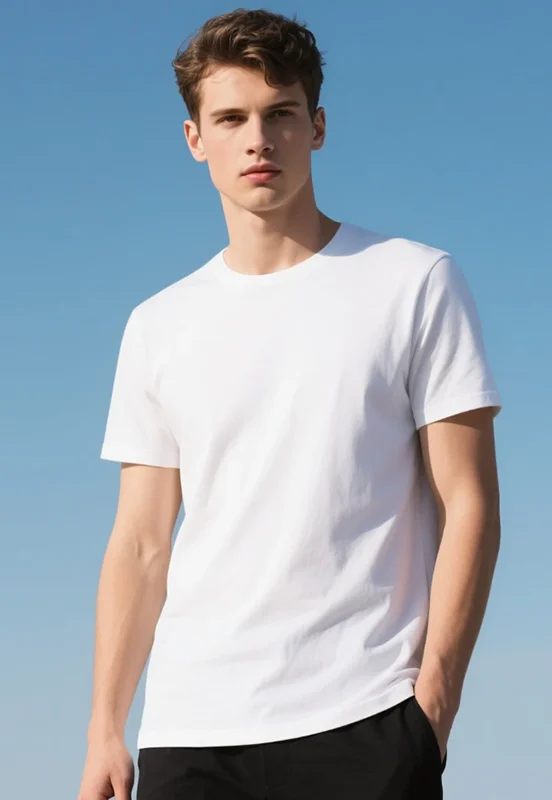
Shoulder Tape, Seam and Stitch Route
Shoulder tape is the component that keeps the neckline from stretching sideways. A strip of tape or binding is stitched along the shoulder seam line from neck to sleeve on each side, which stabilises the seam and limits how much the opening can deform when the garment is put on and taken off. Programmes that print or embroider close to the neck, or that use a heavier fabric, benefit most from a taped neckline, because the tape prevents the shoulder seam from being pulled out of line.
The stitch route then determines how the band and the tape behave together. A coverstitch holds the band flat and stretches with the knit, while a standard overlocked seam is faster but creates a ridge that presses at the neck. Where a programme specifies a taped neckline, the tape width, its shade and its stitch alignment become specification items, because a visible tape of the wrong width or shade is immediately noticeable from the front. Where decoration sits close to the opening, the placement should be measured from the finished neckline rather than from the pattern, since the band is applied under stretch and the finished position differs from the flat pattern.
Cost, MOQ and Lead-Time Consequences
Neckline cost is driven by the band and the number of operations. A narrow rib band with a single seam is the least expensive option; a taller band adds material, a folded band adds a folding and turning operation, and a taped neckline adds a component, an operation and a shade match. Each of those steps also adds an inspection point, which matters on a high-volume programme because the neckline is checked on every garment.
Lead time depends on the band’s availability and on the approval round. Rib in standard colours and heights is often held in stock, while a dyed-to-match band knitted to a specific height is produced against the order and needs its own colour approval. Two decisions keep the schedule stable: keep the neckline specification consistent across the colourways in a range, and approve the band together with the body cloth so that shade and stretch are assessed as a pair. Programmes can start from small quantities, and ready-to-ship t-shirts are available from 1 piece, so a neckline can be evaluated on a trial garment before a season order. Yarn and stitch specification behind the cloth is covered in the yarn count and stitch density guide.
Quality Checks That Catch Neckline Failures
Check the neckline after washing, not only at delivery. The failure mode that matters is lost shape, and it appears after the shirt has been laundered and pulled over the head a few times. Measure the opening width against the approved specification, then measure it again on a washed sample and compare both against the reference garment. Then assess the appearance: a neckline that waves, rolls or sits unevenly is a defect even when the width is inside tolerance.
The inspection list should include:
- Opening width and band height measured against the specification, before and after the stated wash cycle.
- Band condition checked for rolling, twisting and uneven stretch along the opening.
- Stitch quality at the neckline seam, including density, neatness and any skipped stitches.
- Shoulder tape position, width and shade checked where fitted.
- Decoration position measured from the finished neckline rather than from the pattern.
- Appearance and dimensional change after washing, assessed through AATCC test methods.
Material compliance for the body cloth, band and tape can be documented through the OEKO-TEX Standard 100 framework where the market requires it, and care symbols should follow a recognised system such as GINETEX, because drying temperature is one of the fastest ways to lose band recovery.
Repeat-Order Consistency
The neckline is a component that drifts quietly between orders. The band may come from a different knitting lot, be dyed separately from the body, or be sewn under different tension, and each of those changes the finished opening without changing any other measurement. Because the neckline is small, the difference is easy to miss in a shipment inspection and very visible on the customer.
Keep a reference that includes the approved band with its height and stretch result, the body swatch it was matched with, the wash result from the approved bulk, and a garment retained for comparison. Compare each repeat against that reference rather than against the previous delivery, and record the rib reference and the joining tension so that a change can be identified before production. Where a programme runs several colourways, keep one reference garment per colour, because a band matched to a pale shade behaves differently in the eye from the same band on a dark body.
What to Put in the Tech Pack
The neckline block should describe the band and the seam separately. Record the band construction, its height and its stretch or recovery requirement with the method used to verify it; the band colour reference; the shoulder tape specification where fitted, including width and shade; the stitch type and density at the seam; and the finished opening width with its measurement points.
Add the service requirements in the same block: the wash and dry cycle the neckline must survive, the appearance standard it is compared against, and the reference garment kept for bulk. Two further lines prevent most disputes. State the joining tension or the band-to-opening ratio used for the approved sample, because that is the variable that decides whether the finished neckline lies flat, and keep a washed sample alongside the fresh one so that both states of the neckline are defined. LSLONG builds crew, V-neck, henley, oversized, fitted and long-sleeve t-shirt programmes with construction and decoration handled in-house, and the knowledge hub carries the supporting guides on fabric, construction and testing.

FAQ
Why does a t-shirt neckline stretch out after a few washes?
Usually because the band has lost recovery or was joined under too much tension. A rib band that lacks sufficient elasticity, or one stretched excessively during sewing, grows with use and never returns to its original width. High drying temperatures accelerate the loss. Set a recovery requirement, verify it after the stated wash cycle, and record the joining tension used on the approved sample so a reorder can reproduce the behaviour.
Is a taped neckline worth the extra operation?
It is worth it where the shirt carries decoration close to the neck, uses a heavier cloth, or is laundered frequently, because the tape stops the shoulder seam stretching sideways and keeps the opening in shape. The cost is a component, an operation and a shade match. On a lightweight promotional garment a good rib band without tape can be adequate, provided the band recovery and joining tension are controlled.
Does band height matter?
It affects both the appearance and the behaviour. A taller band resists rolling, carries more material to absorb stretch and reads as a heavier, more retail-oriented neckline, while a narrow band is lighter and suits thinner cloth. The band should be specified against the body cloth and the intended market rather than chosen for appearance alone, and the height should be measured on the finished garment because it changes slightly when the band is applied.
How should decoration placement be measured near the neckline?
Measure from the finished neckline rather than from the pattern, because the band is applied under stretch and the finished opening position differs from the flat pattern. State the reference point clearly enough that two inspectors reach the same number, and check the position on the washed garment, since the neckline moves slightly after laundering. Where a programme changes the band height or the band stretch, re-check the placement rather than carrying over the previous measurement.
Specifying t-shirt necklines?
Send the body cloth, the fit, the intended wash regime and the decoration plan, and LSLONG will confirm the band construction, height and joining tension, then sample the neckline with the shoulder and the front panel so the assembly is approved together. Construction, decoration and quality control are handled in-house in Shenzhen.