

Custom t-shirt fit is decided by a small number of pattern relationships rather than by a size label. Body width, body length, shoulder position, sleeve opening and neckline width move together, and a garment is read as boxy, regular, fitted or oversized according to how those relationships sit against each other. That is why two shirts labelled the same size can feel like different products, and why fit development has to start from the relationships the brand wants rather than from a size chart copied from another programme.
What Does the Fit System Change Downstream?
It changes silhouette, decoration and the size range.
The fit system decides how the garment reads on the body, where the decoration sits, how the range grades and how much cloth each size consumes.
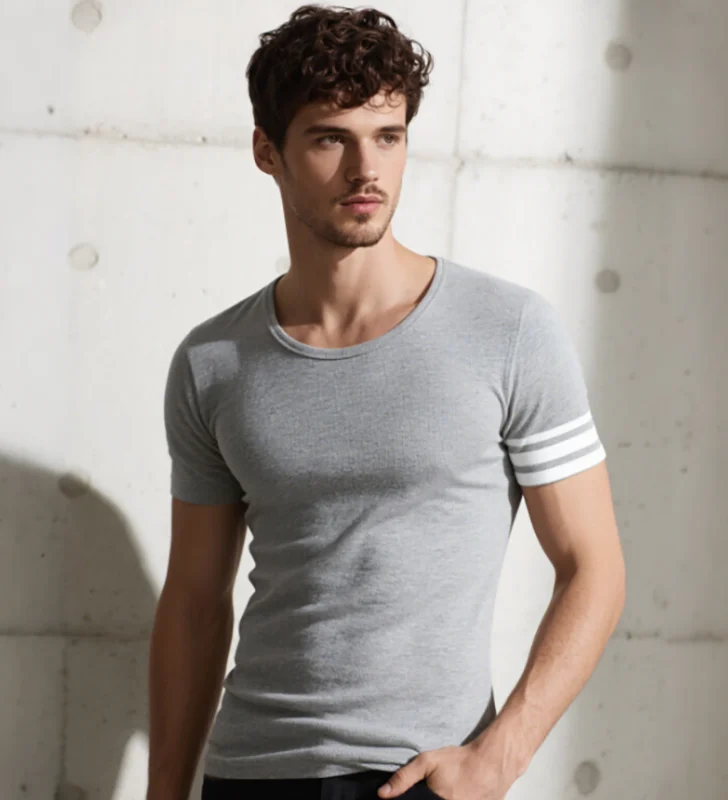
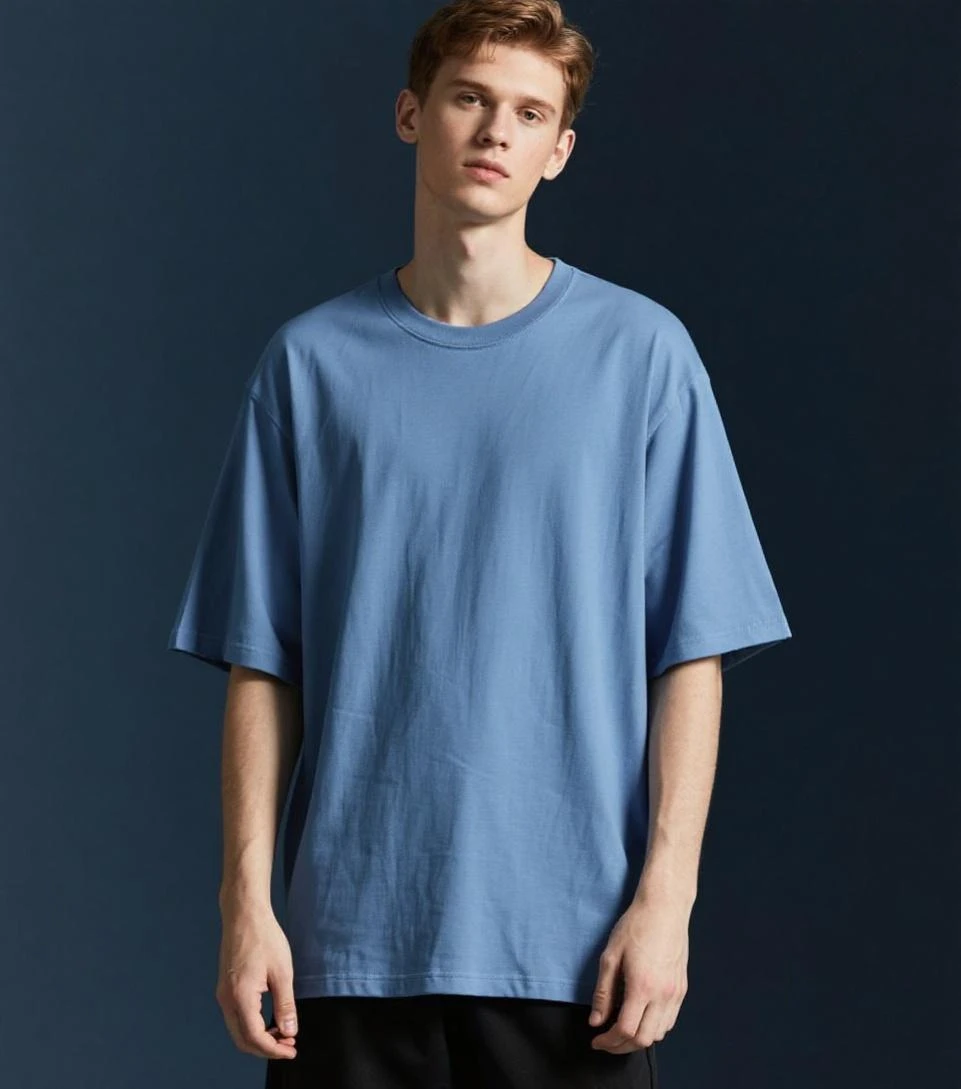
Silhouette is the visible consequence. A boxy body with a shorter length reads as a streetwear shape, while a fitted body with a shoulder that follows the body line reads as a retail basic, and both can be produced from the same fabric at the same weight. The differences are in the pattern: a few centimetres in body width, a dropped shoulder and a change in sleeve opening produce a different product category.
Decoration follows the fit because the printable area is a consequence of it. A fitted shirt has a narrower front panel and a higher neckline, so the chest mark has less room and sits closer to the placket area, while an oversized body offers a wider canvas and a lower shoulder line which changes where a large print can sit without crossing a seam. Cost follows from cloth consumption: an oversized body uses more fabric per garment than a fitted one at the same size, which is why fit decisions are also costing decisions.
Boxy, Regular, Fitted and Oversized: How They Differ in the Pattern
The four common fits differ in measurable ways, and the differences are easier to control when they are written down. Boxy cuts use a wider body and a shorter length with the shoulder close to the body line; regular cuts balance a moderate body width with a standard length; fitted cuts reduce body width and often raise the armhole and narrow the sleeve opening; oversized cuts increase body width, drop the shoulder and extend the sleeve and body length together.
Because the differences interact, changing one measurement without the others rarely produces the intended result. Widening a regular body without shortening it produces a long, loose shirt rather than a boxy one, and dropping a shoulder without widening the body produces a narrow garment that pulls across the chest. The practical way to develop a fit is to set the relationships first, then confirm them on a body rather than on a table.
| Fit | Body width | Shoulder and sleeve | Length | What to check |
|---|---|---|---|---|
| Boxy | Wide with straight sides | Shoulder near the body line, wider sleeve opening | Shorter relative to width | Does the hem sit level and the sleeve clear the arm |
| Regular | Moderate ease | Standard shoulder, straight sleeve | Standard | Chest ease and neckline width in wear |
| Fitted | Close with defined waist shaping | Higher armhole, narrower sleeve | Slightly shorter | Movement across the chest and shoulder |
| Oversized | Wide with dropped shoulder | Extended sleeve, deeper armhole | Longer body and sleeve | Proportion at the extremes of the size range |
Custom T-Shirt Fit: Setting the Base Size and Ease
Start from the base size and the wearer, not from the chart. Identify the body measurement the fit is designed around, then decide the ease the garment should have at the chest, the hem and the sleeve. Ease is what converts a body measurement into a garment measurement, and it is the number that most determines whether the fit reads as intended. Writing ease down explicitly also makes the chart reviewable, because a change in ease is visible as a decision rather than as a measurement error.
Then set the relationships that characterise the fit. Shoulder position relative to the body, armhole depth, neckline width and body length against body width are the four that matter most on a t-shirt, and each should be recorded with a tolerance. LSLONG develops t-shirt patterns across boxy, regular, fitted and oversized builds with grading across XS–5XL and a tolerance of ±0.5 cm on the measurement chart, and the yarn and stitch specification that sits behind the cloth is described in the yarn count and stitch density guide.
Fabric Weight and Drape Effects on Fit
The same pattern produces different fits in different fabrics, which is why fit development and fabric selection belong in the same conversation. A heavier cotton holds the body shape and makes an oversized cut read as structured, while a lighter cloth falls closer to the body and can make the same pattern read as loose rather than oversized. Stretch and recovery behaviour, assessed under methods such as ASTM D2594, affects how the garment behaves once it is worn, particularly at the neckline and the sleeve.
Mass per unit area is verified to ASTM D3776/D3776M so that the sample and the bulk order use the cloth the fit was developed in. Where a programme runs the same fit in two fabrics, sample both, because the drape difference is visible to the customer even when the measurements are identical. Where a fabric substitution is proposed later, treat it as a fit-affecting change and re-approve at least the smallest and largest sizes.
Grading the Fit Across the Range
Review the depth of the armhole alongside the body width when grading, because that relationship determines whether the wearer can move freely at the largest sizes. An armhole that stays shallow while the body widens restricts the arm, while one that deepens too quickly on a narrower body can leave a gap under the arm. Both faults appear at the ends of the range rather than in the middle, which is why the fit set has to cover the smallest and largest sizes even when the programme expects most of its volume at a middle size.
Grading protects the relationships the fit was built on. Body width increases with size, but sleeve length, body length and armhole depth do not increase at the same rate, and the increments should be set to preserve the silhouette rather than to follow a single step. On an oversized build, the shoulder and armhole measurements deserve their own lines in the chart, because proportion failures appear there first, at the largest sizes.
Sample the extremes rather than the middle alone. A fit set covering the smallest, middle and largest sizes in the production cloth is the practical control, judged on a body or a fit model rather than on a stand. The same discipline applies to the neckline: a band that holds its shape on a medium can pull on a large if the front and back neck widths have not been graded with the band stretch in mind.
Cost, MOQ and Lead-Time Consequences
Fit affects cost through cloth consumption and through development time. Wider bodies and longer sleeves use more fabric per garment, which shows up in the unit cost at any volume, and patterns with more panels or shaped seams take longer to cut and sew. Development time is also longer for a fit that differs from the factory’s existing blocks, because the pattern has to be drafted, sampled and approved rather than adapted.
Lead time depends on how much of the development is new. A fit that uses an existing block with a changed length or sleeve can often be sampled quickly, while a new silhouette with different grading needs a full development cycle. Programmes can start from small quantities and ready-to-ship t-shirts are available from 1 piece, so a fit can be validated on a short run before a season order. The commercial sequence for costing and volume breaks is covered in the LSLONG knowledge hub.
Quality Checks That Catch Fit Failures
Include the garment on a body in the inspection plan where the production run is large enough to justify a fit review. A measurement report confirms that the garment matches the chart, and a wear check confirms that the chart still describes the fit that was approved, which is a different question. Where a programme runs for several seasons, the wear check also reveals whether the cloth is behaving as it did on the approved sample, since a change in yarn lot or finishing route can shift the drape without moving a single measurement.
Check the garment on a body before checking it on a table. A t-shirt can measure correctly and still read as the wrong fit, because the relationships between the measurements are what the customer sees. The practical review looks at the shoulder position, the chest ease, the hem position against the hip and the sleeve opening, then confirms the chart at the smallest, middle and largest sizes.
The inspection list should include:
- Body width, body length and shoulder position measured at three points in the range.
- Armhole depth and sleeve opening checked on a body for movement and comfort.
- Neckline width and band behaviour confirmed with the garment worn.
- Hem level checked against the hip and for parallelism with the body.
- Symmetry of side seams and sleeves checked on the flat garment.
- Appearance and dimensional change after the stated wash cycle, assessed through AATCC test methods.
Material compliance for the fabric and trims can be documented through the OEKO-TEX Standard 100 framework where the market requires it, and care symbols should follow a recognised system such as GINETEX so that the labelled drying instruction matches the test the garment passed.
What to Put in the Fit Specification
The fit block should state the base size measurement, the ease at chest, hem and sleeve, the shoulder position, the armhole depth, the neckline width and the body length, each with a tolerance. Add the fabric used for development, with its weight and structure, because the fit was approved in that cloth and not in a generic one.
Then add the grading increments with the relationship each protects, and the fit set that was approved. Two lines close the loop. Record which pattern version the chart belongs to, and keep the approved fit samples at the extremes, because a reorder has to reproduce the silhouette rather than only the measurements. LSLONG builds t-shirt programmes across crew, V-neck, henley, oversized, fitted and long-sleeve bodies with decoration handled in-house in Shenzhen, and the knowledge hub carries the supporting guides on fabric, construction and testing.
FAQ
How is ease decided for a custom t-shirt fit?
Ease is the difference between the body measurement the fit is designed around and the garment measurement. Set it by the intended look: a fitted shirt uses minimal ease at the chest, a regular shirt takes a moderate amount and an oversized shirt takes a large amount plus a dropped shoulder. Write it down as a decision with a tolerance, because a change in ease is the most common reason a reorder feels different from the original garment.
Why does the same size fit differently in two fabrics?
Because drape and recovery change how the cloth behaves on the body. A heavier cotton holds an oversized shape and reads as structured, while a lighter cloth falls closer to the body and can make the same pattern look loose rather than oversized. Stretch and recovery also affect how the neckline and sleeve sit after wear. Develop the fit in the production fabric, and sample again if the fabric changes.
How should a fit range be graded?
Grade to protect the relationships the fit was built on. Body width increases with size, but shoulder position, armhole depth, sleeve length and body length do not increase at the same rate, so the increments should be set per measurement rather than applied uniformly. Check the smallest and largest sizes on a body, because proportion failures appear at the ends of the range before they appear in the middle.
How small can a first run be for a new fit?
Programmes can start from small quantities, and ready-to-ship t-shirts are available from 1 piece, which makes it practical to validate a fit on a short run in the production fabric before committing to a season order. Use that run to check the silhouette on real wearers across the size range, then lock the chart and keep the approved samples as the reference for bulk production.
Developing a custom t-shirt fit?
Send the silhouette you want, the fabric and weight, the size range and the decoration plan, and LSLONG will draft the pattern, set the ease and grading, then produce a fit set at the extremes for approval. Pattern development, decoration and quality control are handled in-house in Shenzhen.