

Buyers ask this the moment they start comparing blanks, usually after noticing that two shirts carrying the same brand name feel completely different in the hand. The reason is that the answer is not a single fabric. It is a style number, and the fiber content is printed on the garment.
This guide explains how to read that label correctly, why the same brand produces several fabric platforms, and how to verify a specification before you commit to a bulk order rather than after the cartons arrive.
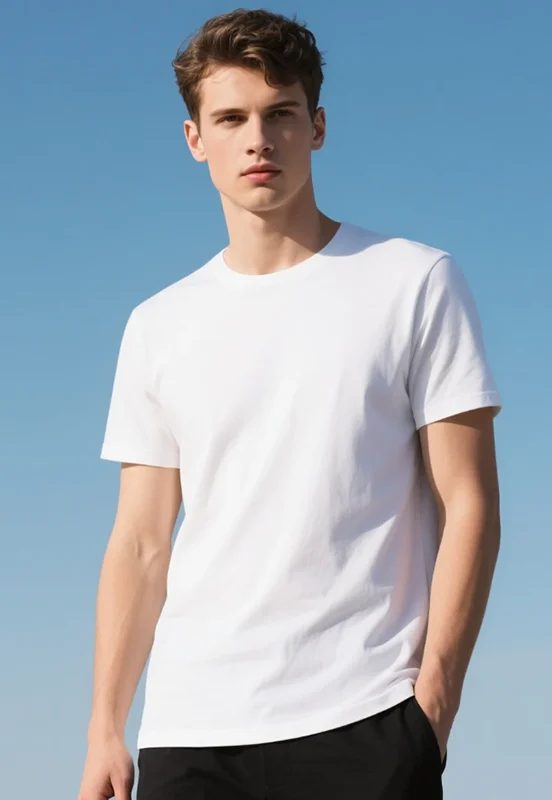
What material are Gildan shirts made of?
Gildan produces several ranges rather than one fabric, so there is no single answer. The fiber content varies by style number and is printed on the garment label.
The brand’s own corporate site describes it as an apparel manufacturer with multiple product lines, which is the key point: cotton, cotton-polyester blends and polyester performance knits all appear across a manufacturer’s range, and each corresponds to a different style number. If you need the composition of a specific shirt, read the label on that shirt or request the current specification sheet for that style number. Anything else is an approximation.
The same discipline applies to any blank you are considering, from any manufacturer. A brand name tells you who made it; it does not tell you what the fabric is.
Where do I find the fiber content of a Gildan shirt?
On the neck label of the garment itself. In the United States this is a regulated disclosure, not a courtesy.
The Federal Trade Commission’s business guidance on the Textile and Wool Acts sets out what textile products sold in the United States must state, including fiber content by percentage, country of origin and manufacturer identification. That matters commercially: a label statement is something you can hold a supplier to, whereas a catalogue description such as premium cotton is not.
| Label element | What it gives you | Why it is useful when sourcing |
|---|---|---|
| Fiber content by percentage | The actual composition, for example a stated percentage of cotton and polyester | Lets you compare two candidate styles on the same basis instead of on feel |
| Country of origin | Where the garment was made | Relevant to duty, labelling and your own market’s requirements |
| Manufacturer identification | Who made it, which is not always the brand | Reveals whether the brand ran the garment itself or contracted it out |
| Care instructions | Washing and drying conditions | Predicts shrinkage and print durability more reliably than any sales claim |
Why do two Gildan shirts feel different if they are the same brand?
Because they are different style numbers built on different fabric platforms, and the difference is structural rather than cosmetic.
The variables that separate two blanks are the ones that determine how the shirt wears and how it decorates: the fiber blend, the yarn type, the fabric weight and the finishing treatment. A heavier open-end cotton knit and a lighter ringspun knit are separate products with separate specifications, separate price points and different behaviour under a screen print or an embroidery head.
This is why comparing blanks by brand alone leads to disappointed bulk orders. Compare style numbers, and compare the fibre percentages and fabric weight that sit behind them.

How do I verify a blank shirt specification before a bulk order?
Four steps, in this order. Each one removes a category of risk before you have committed money.
It helps to think of the specification sheet and the physical label as two views of the same fact. If they disagree, that disagreement is the finding, and it is far cheaper to discover at sample stage than after a bulk delivery.
| Step | What you do | What it catches |
|---|---|---|
| 1. Request the spec sheet | Ask your supplier for the sheet for the exact style number | Assumptions carried over from a different style |
| 2. Order a physical sample | Get the actual garment in the colour and size you will buy | Colour, hand feel and construction differences the sheet cannot show |
| 3. Check the label against the sheet | Compare fiber percentages, origin and care instructions | Substituted fabric or a different production site |
| 4. Test the decoration | Print or embroider the sample before bulk | Print adhesion, dye migration and embroidery distortion on that specific fabric |
What about certified or sustainable cotton claims?
Certification claims are checkable, and they are scoped. A certificate covers a named material and a named supply chain step, so the useful question is not whether a supplier mentions a standard but which certificate covers which material on which order.
Two references are worth knowing when a supplier raises this. OEKO-TEX publishes the testing and certification standards it operates for textiles and leather. Textile Exchange publishes the standards that govern recycled and preferred-fibre claims across the supply chain. Both explain what a certificate does and does not cover, which is exactly what you need in order to ask a precise follow-up question instead of accepting a logo.
What should you ask a custom manufacturer about fabric before ordering?
Five questions, all answerable with documents. They apply whether you are buying a branded blank or commissioning a private-label run.
A manufacturer running its own production should be able to answer these without reaching for a brochure, because the answers come from the specification the line is working to. More detail on how fabric selection interacts with decoration is in our knowledge hub.
| Question | What a complete answer includes |
|---|---|
| What is the exact fiber composition? | Percentages, not a category such as cotton-rich |
| What is the fabric weight? | A stated figure with its unit |
| Which mill or platform does it come from? | A named source you can trace |
| Which certifications apply to this material? | Current certificates with material and site named |
| How does it behave when decorated? | A sample decorated with your intended method |
Gildan Material Lookup: Style and Color Must Be Checked Together
Gildan shirts are not made from one universal material. The style number identifies the product family, while the selected color may change the fiber blend. For example, Gildan’s US page lists the 5000 Adult T-Shirt as 5.3 oz/yd² and 100% US cotton, but the company’s 2026 style guide notes that fiber content varies by color. That distinction matters for print behavior, hand feel, shrinkage expectations and label accuracy.
Last updated:
| Check | Why it matters | Best evidence |
|---|---|---|
| Style number | Names such as Heavy Cotton describe a collection, not every specification | Current Gildan product page or style guide |
| Exact color | Heather, safety and other colors may use blends rather than the solid-color composition | Color-specific specification and sewn label |
| Fabric weight | Weight affects opacity, drape, print feel and perceived durability | Published oz/yd² or g/m² value for the market |
| Country of origin | US cotton does not mean the shirt was sewn in the United States | Country-of-origin label on the actual lot |
| Decoration compatibility | Fiber blend and finish affect curing, dye migration and adhesion | Printer trial on the ordered style and color |
Bulk blank verification checklist
- Record the complete style code, color name, size range and supplier SKU on the purchase order.
- Compare the current official specification with the physical care and fiber label.
- Confirm substitutions are not allowed without written approval.
- Test the intended print or embroidery on the actual color, especially for blended and performance colors.
- Retain one undecorated blank and one approved decorated sample from the same lot.
- Use the finished garment’s actual disclosures when creating any private-label packaging or online copy.
Official product source: Gildan 5000 Adult T-Shirt. For US labeling duties, see the FTC Textile Fiber Rule.
FAQs
Are all Gildan shirts 100% cotton?
No. Material varies by style and can also vary by color within the same style. Check the current style-and-color specification and the sewn label.
Is the Gildan 5000 made from cotton?
Gildan’s US product page lists the 5000 Adult T-Shirt as 5.3 oz/yd² and 100% US cotton, while its style guide notes color-specific fiber exceptions.
Does US cotton mean Made in USA?
No. Fiber origin and garment country of origin are different claims. Verify the country-of-origin label on the actual shirt.
What should a printer verify before a bulk run?
Verify style, color, blend, finish and fabric weight, then run the intended decoration and curing process on an actual sample before approving bulk production.
Sources
- Federal Trade Commission: Threading Your Way Through the Labeling Requirements Under the Textile and Wool Acts
- OEKO-TEX: textile and leather testing and certification standards
- Textile Exchange: supply chain standards for preferred and recycled fibers
- Gildan corporate site: the manufacturer’s own product and company information
- Gildan brand site: current style listings and specification sheets
Commissioning a private-label run instead of buying blanks? LSLONG manufactures custom T-shirts, polos, hoodies, sportswear and surgery shirts in Shenzhen, with fabric sourcing, sampling, cut-and-sew, decoration and branded packing handled in one place. Bring us the fiber and weight specification you want and we will confirm what the fabric library holds, what the sample timeline is, and how the intended decoration behaves on that cloth.