

The brushed fleece vs french terry decision is a costing decision before it becomes a design decision. It fixes the weight you buy, the surface your artwork sits on, the rib that has to recover against the body, and how the garment looks after the twentieth wash. Buyers who treat the three common fleece families as interchangeable usually meet the difference on a bulk wash test rather than on the sample table, when pile migration, loop distortion or a shade that reads differently on a napped face appears across a whole run instead of on one reference piece.
What Does the Cloth Choice Change Downstream?
It sets weight, cost, decoration route and wash behaviour.
A brushed pile holds loft and hides stitch detail, loop-back French terry stays flatter, and an anti-pill finish changes how the surface ages through repeated laundering.
Four items move whenever the cloth family changes. Pattern ease moves, because a napped surface pulls and recovers differently from a flat loop-back knit at the same body measurement. Trim weight moves, since rib, neck tape and drawcord have to balance a heavier or lighter body without collapsing the opening. Decoration moves, because pile absorbs ink detail and changes how a satin stitch sits on the surface. Packing and freight move, because fleece is a volume product and the same piece count ships at a different cube.
The cloth decision therefore belongs in the specification stage, not in the sampling review. A hoodie is a system: body cloth, hood lining, pocket cloth, rib, thread, needle size and decoration method all interact. Swap one element late and the others are re-tested at your cost and on your timeline. That is why the first page of a hoodie tech pack should name the cloth family, the finished face and the weight in g/m² instead of describing a hand feel.
What Buyers Get Wrong When They Compare Brushed Fleece vs French Terry
Most buyers compare the fabric, not the finished garment.
Spec sheets quote a weight per square metre, but the same loop-back cloth becomes a different garment once it is napped, compacted, washed and cut at a different ease.
Three comparison errors recur. The first is quoting weight from the roll rather than the garment: mass per unit area is measured under a defined method such as ASTM D3776/D3776M, and a finished hoodie carries the added weight of its rib, hood and seams. The second is judging colour on two surfaces, because napping scatters light and a mid-tone matched on loop-back can read a shade deeper once the face is brushed. The third is assuming a decoration that behaves on one cloth will behave on the other, then finding on bulk that pile plus dense artwork needs a different mesh, press setting or backing.
Keep the comparison honest by testing both options as garments: same size, same wash cycle, same measurements. Record dimensional change, surface change, colour difference and how the decorated area survives, and ask for the report on the finished garment rather than only on the roll.
How the Three Fleece Families Differ in Manufacture
Loop-back, napped, or napped with a pill-resistant finish.
French terry comes off the knitting machine with loops intact on the reverse; brushed fleece cuts and raises those loops into pile; anti-pill fleece uses a shorter, denser pile plus a finish that slows fibre migration to the surface.
The distinction matters because each step adds processing and shifts what the cloth can do. Terry keeps its loop structure, so it stays relatively flat, prints cleanly and holds a crisp shoulder line. Brushing passes the cloth against rotating rollers that open the loops into a pile, which buys cover, warmth and loft at the price of surface stability. Anti-pill routes start from a shorter pile and add a finish so loose fibres stay locked in the structure rather than balling up where a bag strap rubs.
| Option | How it is made | Surface and hand | Where it fits | Decoration note |
|---|---|---|---|---|
| French terry (loop-back) | Knitted with loops on the reverse; not napped | Flat, dry, visible loop texture | Lighter hoodies, layering pieces, programmes where artwork detail is the point | Screen print and DTG hold fine detail; embroidery needs a stable backing |
| Brushed fleece | Loops cut and raised into pile on one or both faces | Soft, matte, high cover | Winter hoodies, uniform programmes, heavy retail basics | Pile absorbs ink and lifts surface stitches; specify backing for embroidery |
| Anti-pill fleece | Shorter, denser pile with a pill-resistant finish | Smoother, more compact pile | Long wear cycles, frequent laundering, workwear and teamwear | Confirm the finish survives your stated wash regime, not one home cycle |
The table is a starting point, not a specification. Two mills can both label a cloth as brushed fleece and deliver different pile heights, drafting behaviour and shade response, which is why fleece mills such as Polartec publish construction and finish data rather than marketing names alone. Name the finish on the face you care about, and state whether the reverse is brushed, looped or left raw.
Which Cloth Suits Which Hoodie Build?
Match the cloth to the hood, pocket and rib around it.
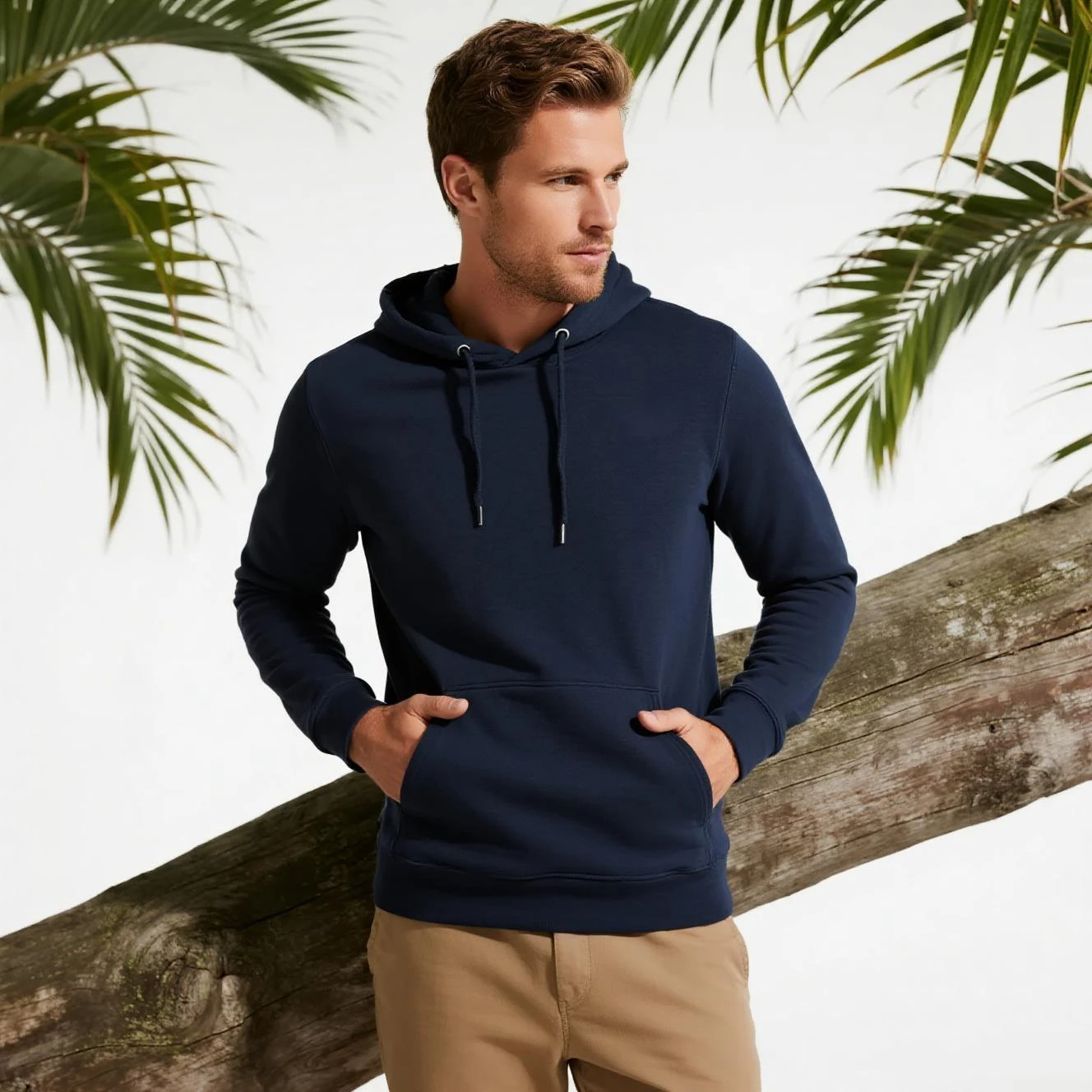
A heavy brushed pile needs rib with enough elastane to recover against the bulk, while loop-back terry keeps a light hood shape, a cleaner shoulder line and a pocket that does not sag under a phone.
Start with the hood. A double-layer hood in brushed fleece gives structure and warmth but adds weight above the shoulders, so a self-fabric outer with a lighter lining often balances better on a heavy body. A terry hood is naturally flatter and suits a lighter shape. Next, the pocket: matching the body cloth in a kangaroo pocket keeps the surface consistent under print, while a lighter pocket bag reduces bulk at the hand openings.
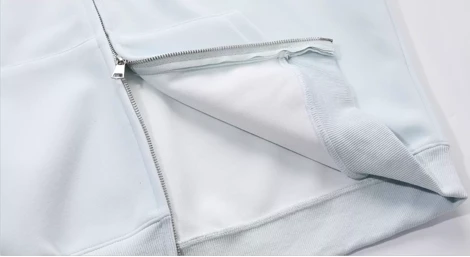
Then the rib, because rib recovery is what stops a cuff stretching out after a season. On zip-through builds the tape and zip gauge must suit the cloth thickness, since a fine zip on heavy pile puckers and a coarse zip on light terry looks out of scale. LSLONG produces pullover, zip-up, quarter-zip, oversized, cropped and fitted hoodies in Shenzhen, with decoration in-house, so a programme can move between screen printing, heat transfer and 3D embroidery without changing supplier or re-approving the cloth.
Cost, MOQ and Lead-Time Consequences
The cloth choice moves cost through three channels: the price of the greige fabric, the processing added to it, and the yield you get per garment. Brushed fabric carries knitting plus a napping and finishing stage, so it usually prices above a comparable loop-back terry. Yield moves the other way, because a napped face with more cover can be specified at a lighter weight for the same perceived warmth, which reduces fabric consumption and freight per carton.
Three drivers are worth controlling before you negotiate:
- Processing steps, including brushing, compacting and any pill-resistant finish.
- Trim count, because rib, tape, drawcord, eyelets and zip all scale with the number of colourways.
- Decoration footprint, since artwork area and colour count drive setup and piece rate more than fabric price does.
Minimums are usually less of a constraint than buyers expect. Hoodie programmes can start from about 50 pieces per style, and in-stock, ready-to-ship garments are available from 1 piece, which allows a low-risk market test before a full production commitment. Lead time is driven by fabric availability and the decoration queue rather than cutting capacity. The cost, MOQ and production guide covers the commercial sequence in detail.
Quality Checks That Catch Fleece Defects
Fleece failures rarely appear as an obvious tear. They surface as a face that balls up under abrasion, a cuff that grows after washing, pile flattened in one direction across half a panel, or a shade that drifts between cartons. Each has a check that can be written into an inspection plan, which turns an argument at the end of production into a pass or fail at the start.
Build these points into the inspection plan:
- Mass per unit area on the finished garment, measured to ASTM D3776/D3776M rather than trusted from the mill ticket.
- Abrasion and surface change on a Martindale-type method, ASTM D4966, reviewed against the appearance standard you approved.
- Colourfastness and pilling behaviour through AATCC test methods that match the wash the garment will actually take.
- Dimensional change after the stated wash cycle, measured against your tolerance rather than a default.
- Nap direction and pile consistency across front, back, sleeve and hood panels in the same light.
- Seam and coverstitch integrity at cuffs, hem and pockets, including chain-off and trim quality.
- Zip cycling, drawcord hardware function and eyelet security on every build that carries them.
Materials compliance belongs on the same list. Where a programme specifies restricted-substance limits, the fabric and trim package can be tested under the OEKO-TEX Standard 100 framework, and any organic fibre claim needs chain-of-custody support through a scheme such as GOTS.
LSLONG runs these checks against the approved reference through its own quality process and lists ISO 9001:2015, ISO 14001:2015 and ISO 45001:2018 management-system certification; ask for the certificate scope to confirm which site and product line it covers before citing it yourself.
Keeping Repeat Orders Consistent
A first order proves the design; the second order proves the supply chain. Fleece is unforgiving here, because a small shade shift is far more visible on a large napped surface than on a flat knit, and because pile height changes how a print or embroidery reads. Consistency is a documentation problem before it is a production problem: if the approved reference exists only as a photograph, every reorder becomes a new negotiation.
The reference pack for a fleece hoodie should hold the approved garment in each colourway, the cloth swatch with weight and finish recorded, the Pantone reference the colour was matched to, and the test report from the approved bulk. Pantone matching with a colour difference of ΔE ≤ 1.0 gives a numeric target instead of a verbal one, and batch-to-batch control keeps successive deliveries inside the same band. Store the swatch away from daylight and label it with the fabric lot.
What Belongs in the Tech Pack?
Cloth family, weight, finished face, test method.
Add pile direction, acceptable dimensional change after washing and the standard each claim is measured against, so the bulk run has an objective target instead of an interpretation.
A hoodie tech pack that survives a reorder contains the cloth family and the face that is finished; the weight in g/m² with the test method named; the colour reference and approved Pantone number; the construction call-outs for hood layers, pocket type and rib; the measurement chart across XS–5XL with the tolerance stated, which for LSLONG programmes is ±0.5 cm on the graded chart; the decoration artwork with placement, colour count and stitch or print specification; labelling and care requirements for the destination market; and the packing specification, including polybag, hang tag and barcode instruction.
Two lines prevent most disputes. State the pile direction on the cutting ticket so panels run the same way, and name the wash cycle the finished garment must pass, including temperature and drying method. With those in the pack, an inspection measures the order against the document rather than against opinion; the LSLONG knowledge hub carries the supporting guides for fabric, testing and decoration.
FAQ
Is brushed fleece warmer than French terry at the same weight?
At the same mass per square metre, a brushed face traps more still air in the raised pile, so it usually feels warmer and reads heavier on the body. The gap narrows when the terry is specified at a heavier weight, which is the usual fix for a programme that wants warmth without the nap. Test both as finished garments in the same wash cycle before you commit, because perceived warmth also depends on hood layers, rib recovery and how tightly the garment sits at the wrist and hem.
Do pill-resistant finishes stop pilling permanently?
They slow it rather than remove it. A pill-resistant finish reduces how quickly loose fibres migrate to the surface, but abrasion from bag straps, seat belts and repeated laundering will still change the face over time. Set the expectation with an appearance standard approved on a washed sample, and state the wash regime the finish must survive. If a programme needs a tight, stable surface for a long service life, a finer, denser pile with a controlled fibre mix usually performs better than relying on the finish alone.
Can the same artwork be printed on French terry and brushed fleece?
The artwork file can be the same; the production settings should not be. Pile absorbs ink and blurs fine lines, so a screen print on brushed fleece often needs a thicker deposit and a looser mesh, while the same design on loop-back terry holds finer detail. For embroidery, pile needs a backing that stops stitches sinking into the surface. Approve each cloth separately with its own strike-off or sew-out, even when the artwork file and colour references are identical.
What is the smallest hoodie order for testing a new cloth?
A hoodie programme can start from about 50 pieces per style, and ready-to-ship stock is available from 1 piece when you want to test fit or finish before committing to fabric production. Trial quantities are the lowest-cost way to validate a cloth change, because they expose pile behaviour, shrinkage and decoration results on a real garment. Ask for the minimum alongside the volume break so you can see where unit cost starts to fall.
Specifying a fleece hoodie programme?
Send the cloth family, target weight in g/m², colourway count and artwork placement, and LSLONG will review the specification against the fabric library, decoration method and quantity. Sampling, decoration and quality control are handled in-house in Shenzhen.