

Polo sample approval is a sequencing problem. Most rework does not come from a factory failing to follow instructions; it comes from approvals taken out of order, so that a cloth change arrives after the colour was approved, or a colourway is confirmed before the fabric has been tested. Each approval in a polo programme depends on the one before it, and a programme that approves the decoration before the cloth is fixed will repeat that approval when the cloth changes. The sequence is the control.
What Does a Sampling Programme Have to Deliver?
A garment that can be reproduced in bulk.
The programme has to prove the cloth, colour, construction, fit and decoration in an order that lets each approval stand on the previous one, and leave a reference that bulk can be measured against.
Each round of sampling has a specific job. The first round confirms that the design can be made as drawn, and exposes the construction decisions that the artwork did not anticipate. The second confirms corrections and locks the measurement chart. A pre-production sample then confirms that the approved specification can be produced with the actual production materials, which is a different question from whether the design works, because production cloth, production trims and production decoration all differ slightly from sample-room versions.
The deliverable at the end of the sequence is not just an approved garment, but an approved reference: the sample itself, the measurement chart it was checked against, the colour reference, the decoration sample and the wash result. Without those, the bulk inspection has nothing objective to compare against and the programme returns to opinion.
The Approval Sequence from Cloth to Bulk
Start with the cloth and the colour, because everything else sits on them. Approve the fabric structure, weight and finish against the specification, and approve the shade as a lab dip on that material before booking production cloth. This is the lowest-cost point at which a wrong cloth or an unattainable shade can be identified.
Then move to construction, using a sample in the approved cloth. Confirm the collar build, the placket, the cuff or hem finish and the side seams, and confirm that the garment can be assembled without the construction fighting the cloth. Approve the fit at the smallest, middle and largest sizes next, and lock the measurement chart. Only then approve the decoration, because thread and ink colours are judged against the garment rather than against a chart. Finally, produce a pre-production sample with the production materials and confirm it against the reference before the bulk run starts. Sequencing the approvals this way means a change late in the process affects only the later stages rather than reopening everything.
Polo Sample Approval: What Each Round Has to Prove
Every round should have a written purpose, and the sample should be assessed only against that purpose. A first sample that is judged on shade, placement and fit simultaneously produces a list of comments that cannot be attributed to a single cause, and the next round then corrects several things at once and obscures which change fixed which problem.
| Round | What it proves | Materials used | What it should not be judged on |
|---|---|---|---|
| Fabric and colour | Structure, weight, finish and attainable shade | Production-intent cloth, lab dip | Construction detail and decoration |
| First sample | Construction, assembly and fit intent | Approved cloth, substitute trims where necessary | Final colour and decoration position |
| Fit set | Graded chart at the smallest, middle and largest sizes | Approved cloth, locked pattern | Decoration, which is approved later |
| Decoration sample | Placement, size and colour of print or embroidery on the garment | Production cloth and correct colourways | Fit, which is already locked |
| Pre-production sample | The specification can be produced with production materials | Production cloth, trims and decoration | Design changes, which should be closed |
Written purposes also make approval faster, because a reviewer knows what to look at and can sign off the rest of the garment as not yet under review. Where a programme has a limited approval window, that discipline is what keeps the timeline intact.
Sizing, Fit and Construction Checks
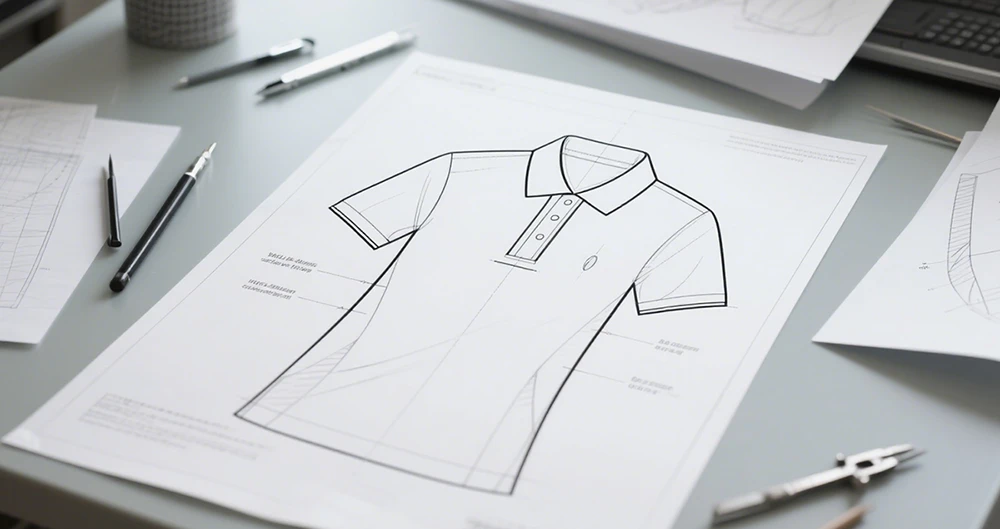
Fit approval should be a session rather than a formality. Bring the smallest, middle and largest sizes together in the production cloth, judge them on a body or fit model with the intended layer underneath, and attach each comment to a named measurement point so the correction is unambiguous. Collar behaviour, placket closure and hem level should be assessed in the same session, because they interact with fit and are usually judged by the same person who will wear the garment.
Construction checks confirm that the assembly matches the intent. Verify the collar build and interlining, the placket construction and interlining, the cuff or hem finish, the side seam and vent treatment where fitted, and the stitch types used at each of those points. Then confirm the measurement chart at the extremes, not only at the base size, and record the tolerance. LSLONG grades polo programmes across XS–5XL with a tolerance of ±0.5 cm on the measurement chart, which gives the sample review and the bulk inspection a shared reference. Where the programme is procured under a tender, the sample approval record often has to include the test and certification documentation alongside the garment.
Fabric, Colour and Decoration Approvals
Fabric approval covers more than appearance. The sample should be checked for structure, weight to ASTM D3776/D3776M on the finished garment, recovery behaviour under ASTM D2594, and the finish applied to the face. Colour approval should be recorded numerically as well as visually, with the approved reference stored away from daylight and labelled with the material and the date.
Decoration approval is where polo programmes most often repeat a round unnecessarily. Thread and ink are separate materials from the cloth, so the decoration needs its own approval against the garment, in the production colourway, at the specified position and size. Embroidery should be approved as a sew-out on the production knit, because a textured pique accepts a mark differently from a smooth interline or jersey, and printing should be approved as a strike-off on the same cloth for the same reason. Then wash the approved decorated sample through the stated cycle and keep the washed version as the reference, because the customer judges the decoration after laundering rather than at delivery.
Quality Control and Inspection Points
Sampling and bulk inspection should use the same criteria, so that the standard approved on the sample is the standard applied to production. The practical approach is to write the inspection points during sampling rather than after: as each feature is approved, record how it will be measured on the bulk order, at what size and under what conditions.
The inspection list for a polo programme should include:
- Measurement chart checked at the smallest, middle and largest sizes against the locked version.
- Cloth structure, weight and finish verified against the approved material specification.
- Shade measured against the stored reference, with the result recorded.
- Collar, placket and hem inspected on a washed sample as well as a fresh one.
- Decoration position, size and colour compared against the approved decorated sample.
- Appearance and dimensional change after the stated wash cycle, assessed through AATCC test methods.
Independent verification can be used at this point where the programme requires it, and laboratories such as Hohenstein test garments against recognised methods. Material compliance for the fabric and trims can be documented through the OEKO-TEX Standard 100 framework, and care symbols should follow a recognised system such as GINETEX so the labelled instruction matches the cycle the sample passed.
Reorder and Continuity Planning
The sample approval file becomes the reference pack for every later order. Keep the locked measurement chart, the approved garment and its washed counterpart, the cloth swatch per colourway with weight and finish recorded, the colour reference, and the approved decoration sample. Label each item with the order reference and keep them together, because a reference that cannot be found is treated as a reference that does not exist.
On a repeat order, sampling has a narrower purpose: confirm that the new cloth lot, trim batch and dye run reproduce the approved result. That means the sample is compared against the stored reference in the same light, at the same size, with the same decoration. Where the cloth source, the construction or the trim supplier changes, treat it as a specification change and re-approve the affected stage rather than the whole garment, which is exactly what the sequenced approval structure makes possible.
Budget and Volume Considerations
Sampling is a fixed development cost, and its value is measured against the cost of correcting a bulk order. Two sample rounds and a fit set are normal for a new polo style; a third round usually indicates that the specification was not closed before sampling began. The decoration approval has its own setup cost in screens, films or digitising, and that setup is repeated if the cloth or the colourway changes after approval, which is the clearest financial argument for approving cloth and colour first.
Volume decisions interact with sampling in one specific way: sample quantities and production quantities are priced differently, so a programme should not judge unit economics on the sample invoice. Polo programmes can start from about 50 pieces per style, and in-stock polo shirts are available from 1 piece, which allows a style to be validated on a small run without a full production commitment. The sourcing and quality context around sampling is covered in the low MOQ polo sourcing guide, and the fabric decisions that are approved first are set out in the polo fabric and GSM guide.
What Belongs in the Approval Record
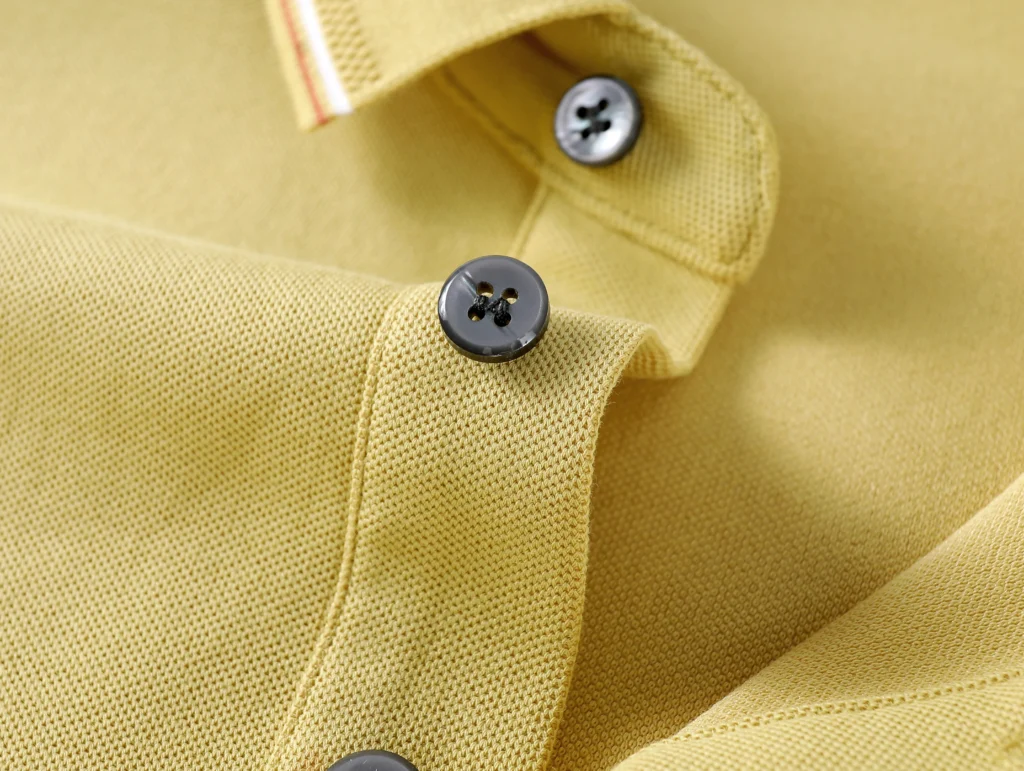
The record should let someone who was not involved reproduce the decision. It contains the sample round and its purpose, the materials used, the measurements taken, the visual approvals with the light source used, the decoration references, the wash result, and the list of corrections carried into the next round. Where a comment was declined, record why, so that the same point is not raised again in a later round.
Two additions make the record durable. Note the cloth lot and trim references used for the approved sample, because the sample is only reproducible if the materials are known, and note the approval dates, since a programme with a long gap between approval and production may need to re-confirm shelf life on adhesives and interlinings. With those in place, the sample approval file becomes the operating document for the order rather than a set of photographs in an inbox, and the knowledge hub carries the supporting guides on fabric, construction and decoration.
FAQ
How many sample rounds does a new polo style usually need?
Two rounds are normal: the first confirms construction and fit intent, the second confirms corrections and locks the measurement chart. A fit set across the smallest, middle and largest sizes is usually produced alongside the second round, and a pre-production sample confirms that the specification can be produced with production materials. A third round generally means the specification was still open when sampling started rather than that the factory could not make the garment.
Why should the cloth be approved before the decoration?
Because the decoration is judged on the cloth, and thread or ink behaves differently on each material. If the cloth changes after the decoration is approved, the screens, films or digitising may need to be redone and the approval repeated. Approving the fabric and the shade first means the decoration is approved once, on the material that production will actually use, and the sample remains a valid reference for the bulk order.
What should we keep as the bulk reference?
Keep the approved sample and a washed version of it, the locked measurement chart, the cloth swatch for each colourway with weight and finish recorded, the colour reference and the approved decoration sample. Label everything with the order reference and store it away from daylight. On a repeat order, the bulk is checked against that reference rather than against the previous delivery, which may itself have drifted slightly.
Can sampling be skipped on a repeat order?
Full sampling can be reduced, but not removed. A repeat order still needs confirmation that the new cloth lot, trim batch and dye run reproduce the approved result, which is a narrower check than a first-order sample but not an optional one. Where the cloth source or a component changes, treat it as a specification change and re-approve the affected stage, leaving the rest of the approval intact.
Sequencing approvals for a polo programme?
Send the design, the colourways, the size range and the target delivery date, and LSLONG will set out the sampling rounds, the sequence of approvals and the reference material that will carry through to bulk. Sampling, decoration and quality control are handled in-house in Shenzhen.