

Compression garment manufacturing is a fit engineering exercise before it is a sewing exercise. The garment only performs if the cloth recovers to the intended tension around the intended body zone, and that depends on the knit, the elastane package, the pattern, the seam and the size grading working together. Buyers who specify compression by fabric name alone usually receive garments that feel tight in the shop and lose their tension after a few washes, because the properties that create compression are recovery properties rather than stretch properties.
What Does Compression Construction Change Downstream?
It sets tension, recovery, comfort and seam load.
The construction decision decides how much tension the garment applies, where that tension sits on the body, how the cloth recovers after washing and how much load the seams carry.
Tension is the purpose of the garment. A compression piece is designed to apply a controlled pressure to a body zone, and the pressure comes from the difference between the garment’s relaxed circumference and the wearer’s measurement. That difference is created by the pattern and the cloth together, which is why a compression garment cannot be graded by scaling a standard base layer: the tension relationship has to be maintained across the size range, not only at the sample size.
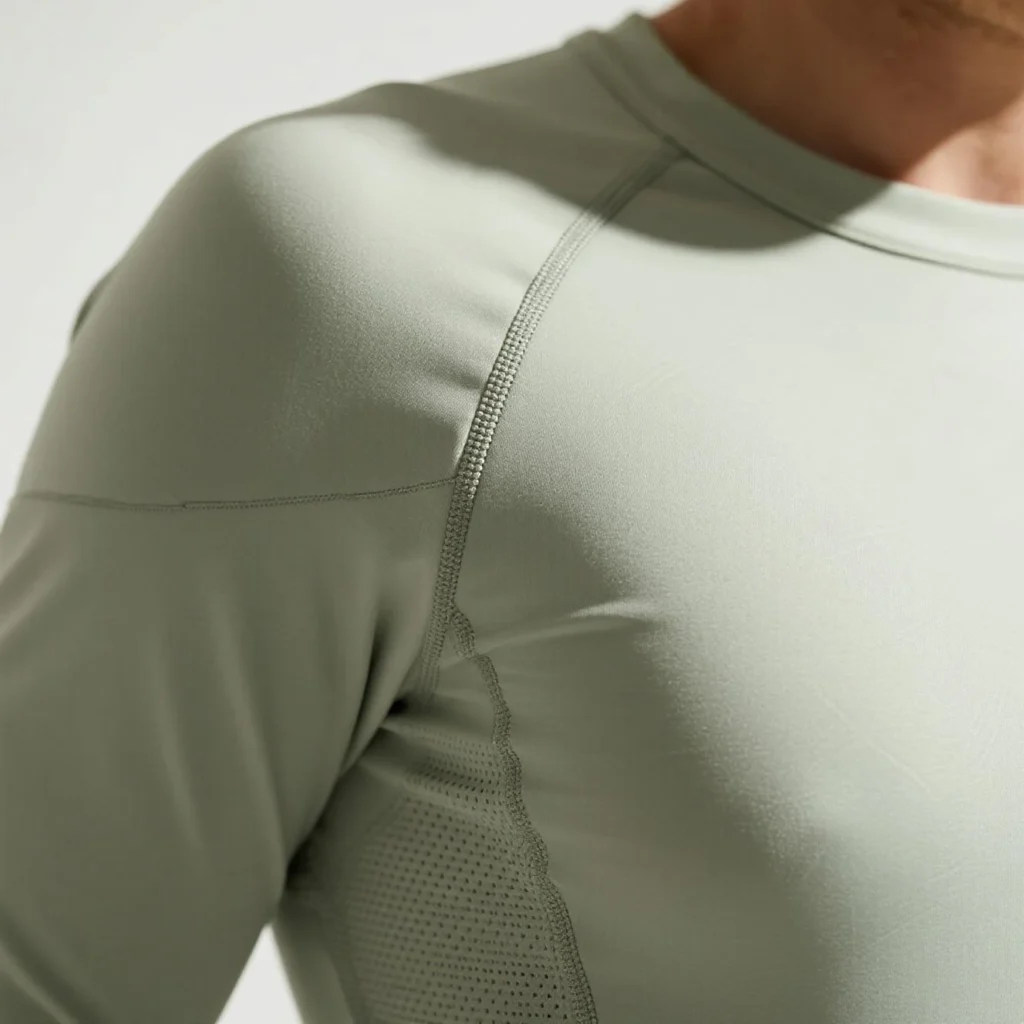
Recovery is what keeps that tension in service. A knit can stretch without returning, and a garment made from such a cloth will feel correct on the first wear and progressively looser afterwards. Seam load follows: because compression garments are worn under tension, their seams carry a constant stretching force, which is why flatlock and coverstitch construction is standard on these garments and why a standard overlocked seam is the wrong specification. Comfort closes the loop, since a garment that rolls, chafes or rides up will not be worn regardless of its technical performance.
How Do the Main Compression Builds Differ in Manufacture?
By knit type, panel count and seam construction.
A circular-knit seamless build uses one tube of cloth with engineered zones, a cut-and-sew build uses panels joined with flatlock seams, and a hybrid build combines both approaches.
Circular knit builds are produced on machines that knit a tube with varying structure along its length, so the compression zone is engineered into the cloth rather than created by panel shaping. The advantage is comfort, because there are almost no seams to chafe, and the limitation is design freedom: the zones are defined by the machine program, and complex colour blocking or panel-specific graphics are difficult to achieve.
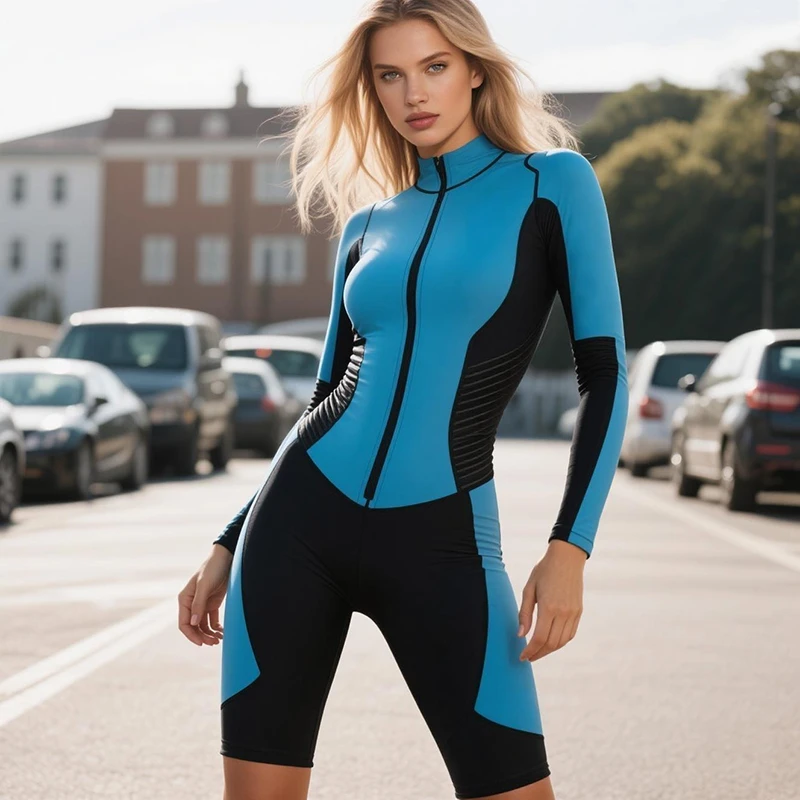
Cut-and-sew builds start from a knitted fabric and shape the garment with panels. That allows different cloths in different zones, engineered colour blocking and precise pattern control, at the cost of seams and more assembly operations. The seams have to be flatlock or coverstitch, because a standard overlocked seam creates a ridge under tension and will fail where the garment is stretched. Most performance compression on the market uses this route, and the assembly detail that governs its behaviour is covered in the flatlock and seamless construction guide.
| Build | How it is made | Behaviour | Where it fits | What to watch |
|---|---|---|---|---|
| Circular knit seamless | Tube knitted with engineered zones | Few seams, high comfort, zones built into the knit | Base layers, running and cycling programmes | Design limits and zone placement tied to the machine program |
| Cut and sew | Panels cut from fabric and joined with flatlock seams | Design freedom, zoned fabrics, engineered placement | Teamwear, leggings, technical tops | Seam quality, panel-to-panel tension and shade matching |
| Hybrid | Knitted tube with cut panels for detail | Comfort at the core with design freedom at the edges | Programmes needing both comfort and graphics | Consistency of tension where panels join the knitted body |
Fabric Pairing: Which Knit Suits Which Compression Zone
Pair the knit to the zone rather than to the garment. A zone that needs firm support calls for a denser knit with a higher elastane content and more recovery, while an area that has to move, such as behind the knee or under the arm, needs a lighter, more elastic structure with less resistance. The result is usually a garment built from two or three cloths, with the transitions specified rather than improvised on the cutting table.
Fibre choice follows the same logic. Elastane content governs recovery, and fibre suppliers such as LYCRA and Hyosung publish elastane options with defined stretch and recovery characteristics that can be written into the specification. Stretch properties of knit fabrics are assessed under methods such as ASTM D2594, and for woven stretch components the relevant method is ASTM D3107. Where the garment includes a polyester or polyamide base, the moisture behaviour of that fibre also matters, because a compression piece is worn against the skin for the duration of the activity. LSLONG produces compression gear and performance sportswear in Shenzhen with in-house cutting, sewing and decoration.
Compression Garment Manufacturing: Fit, Zones and Grading
Grading is where most compression programmes fail. The pressure a garment applies depends on the relaxed circumference of the cloth relative to the body, so as sizes increase, the same percentage reduction produces a larger absolute force. That is why compression garments are usually graded on a percentage basis rather than by fixed increments, and why the fit has to be checked on real wearers at both ends of the range rather than on a stand.
Zone placement is the second variable. Zones are specified by the distance from a fixed reference, such as the hem or the centre back, and those distances do not scale linearly with body size. A zone that sits correctly on a medium can end up above or below the intended muscle group on a large if the placement is simply graded. Specifying each zone by its functional position and checking it on a wearer at the smallest, middle and largest sizes converts the pattern from a sketch into a garment that performs.
Cost, MOQ and Lead-Time Consequences
Compression garments cost more than standard performance wear for structural reasons. The cloth usually has a higher elastane content, which raises the fibre cost, and the knitting route for a seamless build is slower per metre than flat fabric production. Assembly adds further cost, because flatlock seams take longer than overlocked seams and a multi-panel, multi-zone garment multiplies the operations. Grading and fit work is also heavier, since the tension relationship has to be validated at the extremes.
Lead time is driven by the knit and the elastane supply rather than by sewing capacity, because compression fabrics are produced against the order and the construction has to be validated before bulk. Two decisions keep the schedule practical: keep the knit and the zone layout consistent across colourways, and approve the fit and the seam construction before the fabric is ordered. Programmes can start from small quantities, and ready-to-ship stock is available from 1 piece, so a wearer trial can validate tension before a production commitment. Fabric weight and structure selection for performance programmes is covered alongside the other cloth options on the sportswear range.
Quality Checks That Catch Compression Failures
Test under tension and after washing. A compression garment carries a constant stretching load, so the failures that matter appear when the garment is on a body or under a load test, not when it lies flat on an inspection table. Check the seam behaviour first, because that is where most field failures occur, then the recovery of the cloth, then the fit on a wearer.
The inspection list should include:
- Seam type and condition at every join, checked for flatlock integrity, skipped stitches and bulk under tension.
- Stretch and recovery of each cloth confirmed against the specification, with the method recorded.
- Recovery after the stated wash cycle, measured on a marked length of the garment rather than judged by hand feel.
- Zone placement measured from the specified reference point at the smallest, middle and largest sizes.
- Fit and comfort assessed on wearers, including whether the hem, cuff or waistband rolls or rides up.
- Appearance and dimensional change after washing assessed through AATCC test methods.
Material compliance for the knit and trims can be documented through the OEKO-TEX Standard 100 framework where the market requires it, which matters on a garment worn directly against the skin for extended periods. Moisture behaviour is a separate subject, and the principles behind wicking fabrics and how they perform over time are covered in the moisture-wicking performance guide.
Repeat-Order Consistency
Compression garments are sensitive to cloth variation in a way that standard garments are not. A small difference in elastane content or knit structure changes the tension the garment applies, and because the difference is felt rather than seen, it is often noticed by the wearer before it appears in any inspection report. A repeat order that uses a different elastane batch or a differently tensioned knit can feel noticeably looser or tighter than the first.
Record the cloth reference, the elastane specification, the knit tension settings and the seam settings for the approved sample, and re-approve against a stored reference garment on each repeat rather than against the previous delivery. Keep the relaxed and stretched dimensions of a marked panel from the approved sample, because they are the quickest way to detect a change in cloth behaviour. Where a programme runs for several seasons, re-test recovery on the new lot before cutting, since it is cheaper to reject a roll than a finished order.
What to Put in the Tech Pack
The compression block should describe the cloth and the tension requirement. Record the knit structure, fibre and elastane content, the weight in g/m² with its method, the stretch and recovery requirement with the test method, and the relaxed and stretched dimensions of the base panel. Then record the construction: panel layout, seam type and stitch specification at each join, and the zone positions with their measurement points.
Add the graded chart with the tolerance, the fit intent for each zone, and the wash cycle the garment must survive with the recovery result recorded for the approved sample. Two lines close the loop: keep the approved reference garment and its marked panel, and note the knit tension settings used for the approved bulk, because those settings are the difference between two orders that look identical and feel different. LSLONG builds compression and performance programmes with construction, decoration and quality control handled in-house, and the knowledge hub carries the supporting guides on fabric, construction and testing.
FAQ
What makes a compression garment different from a tight-fitting base layer?
The specified tension and its recovery, not the fit alone. A base layer is designed to sit close to the body and move with it, while a compression garment is engineered to apply a controlled pressure to a zone, which requires a denser knit, a higher elastane content and a pattern that maintains that tension across the size range. The practical difference appears after washing, when a base layer relaxes and a correctly built compression garment recovers.
Can compression garments be graded by scaling a standard pattern?
Not reliably. Compression depends on the relationship between the relaxed circumference of the cloth and the body, and the same percentage reduction produces a larger absolute force as sizes increase. Grade on a percentage basis, check the zone positions on wearers at the smallest and largest sizes, and confirm the result on a body rather than a stand, because a stand does not reflect how the cloth tensions around a moving wearer.
Why do compression seams fail before the fabric does?
Because the seams carry a constant stretching load while the garment is worn. A seam that is bulky, unevenly tensioned or built with a thread that does not elongate with the knit will fail at the point of maximum stretch. That is why flatlock and coverstitch construction is standard on these garments, and why the seam specification including thread type belongs in the tech pack rather than being left to the line.
How small can a compression garment order be?
Programmes can start from small quantities, and ready-to-ship stock is available from 1 piece, which makes it practical to run a wearer trial before committing to fabric production. A trial with a small group across the size range exposes the two failures laboratory testing misses: tension that is uncomfortable in use, and seams that chafe under prolonged wear. Keep the trial garments as references for the bulk order.
Developing a compression or performance programme?
Send the sport, the zones, the size range and the intended tension, and LSLONG will confirm the knit, the elastane package, the seam construction and the grading approach, then produce a wearer trial before bulk production. Construction, decoration and quality control are handled in-house in Shenzhen.
Request a compression development review and sample quotation