

A shoulder surgery shirt has to solve a problem that ordinary clothing cannot: the patient may not be able to raise the arm, pull a garment over the head or reach behind the back, often for several weeks. The garment therefore has to be put on and taken off with one functioning arm, without disturbing a dressing, a sling or a drain, and it has to do so repeatedly during the recovery period. The design decisions that make this possible are concentrated in the closure system and its placement, which is why closure position is the first specification item rather than a styling detail.
What Does a Shoulder Surgery Shirt Have to Solve?
Dressing without arm movement or undressing.
The garment has to be put on with one arm, allow access for dressing changes and monitoring, and stay comfortable against skin that may be sensitive or covered by dressings.
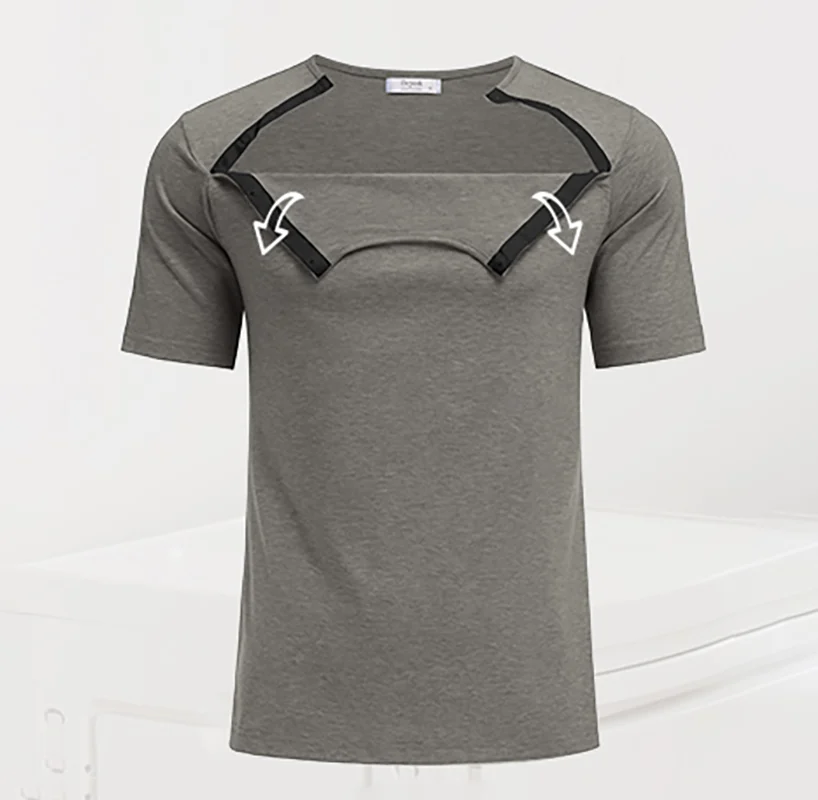
The first requirement is dressing mechanics. A garment that opens fully along the side or the front can be laid out, the affected arm placed into it without raising the shoulder, and the closure closed afterwards; a garment that relies on over-the-head entry cannot be used by a patient with limited shoulder movement. That single constraint eliminates most standard constructions and drives the pattern, the closure choice and the length of the opening.
The second requirement is clinical access during wear. Dressings may need checking, drains may need to be visible or supported, and a sling may need to sit over or under the garment. Each of those affects where the opening sits, how wide it opens, and whether the garment can be partly lowered rather than removed. The third requirement is comfort, which depends on the fabric’s finish, the seam placement and whether the closure hardware presses against skin or against a sling strap.
Design and Closure Placement for Shoulder Access
Place the opening where the arm can reach it, not where the seam is convenient. For shoulder recovery, the practical options are a full side opening, a front opening with an extended placket, or a shoulder-and-side opening that lets the garment be laid around the arm. Each works, and each has a different effect on how the garment behaves when the patient is seated, lying down or using a sling.
Closure placement then follows the reach envelope. The patient’s functioning arm should be able to reach every closure point without crossing the body awkwardly or gripping behind the back, which usually means closures arranged in a vertical line down the side or the front rather than around the back. Closure spacing matters as much as position: too far apart and the opening gapes between them, too close together and dressing takes longer with one hand. The available closure families and how they compare are covered in the adaptive apparel closure and access guide.
| Opening | How it works | Where it helps | What to consider |
|---|---|---|---|
| Full side opening | Garment opens along the side seam and part of the shoulder | Patients who cannot raise the arm at all | Closure count, gaping and overlap at the shoulder |
| Extended front opening | Front opening extended below the usual placket | Patients who can use one hand in front of the body | Reach and hand strength; closure size |
| Shoulder and side opening | Combination that allows the garment to be laid around the arm | Early recovery and dressing changes | Number of steps to close; hardware position against the sling |
| Partial opening with stretch | Stretch panel with a smaller opening | Later recovery and daily wear | Stretch recovery and how the panel feels against dressings |
Fabric and Skin-Contact Requirements
Fabric for a recovery garment is specified for skin contact first and appearance second. The cloth should be soft, breathable and free from rough seams or scratchy finishes, and it should tolerate the wash regime of a hospital or a home carer, which is often hotter and more frequent than domestic laundry. Knitted fabrics with some stretch generally suit recovery garments better than rigid wovens, because they accommodate a sling and a dressing without pressing on the wound area.
Two practical specifications follow. First, the finish: softeners and surface treatments should be tested for skin contact and for durability, since a finish that irritates or washes out defeats the garment’s purpose. Second, the seams: flat or bound seams at the skin-facing side reduce pressure and chafing, and the closure hardware should be placed so that it does not sit against the body. Restricted substance testing for the fabric and trims can be documented through the OEKO-TEX Standard 100 framework, which is a common requirement for garments worn against healing skin.
Sizing, Fit and Dressing Without Arm Movement
Sizing for a recovery garment cannot rely on the patient’s usual size. Swelling, dressings and a sling all change the effective body measurement, and a garment that fits well before surgery can be unusable afterwards. The practical approach is to build extra ease into the chest and armhole area, specify a range that covers the change in shape as well as the change in size, and confirm the fit on a trial wearer with a comparable mobility restriction rather than on a fit model.
Then check the dressing sequence, not only the fit. Lay the garment out, place the affected arm without raising the shoulder, close the closure with one hand, and remove it in reverse. Where that sequence is awkward, the pattern or the closure placement needs revising, not the fabric. LSLONG programmes are graded across XS–5XL with a tolerance of ±0.5 cm on the measurement chart, and for recovery garments the graded chart should be extended with the ease specification, because the garment has to accommodate a dressing rather than only the body.
Regulatory and Documentation Pathway
Whether a garment is regulated as a medical device depends on its intended purpose, the claims made for it and the market it is sold in, and that determination belongs with the brand and its regulatory adviser rather than with the manufacturer. What a manufacturer can do is supply the documentation the brand needs: material specifications and test reports, construction details, and manufacturing records that support traceability.
Two frameworks are commonly referenced when a garment is marketed with a medical purpose. In the United States, the FDA publishes device classification information and the associated regulatory requirements that apply to a given intended use, and its guidance on classifying a medical device sets out how that assessment works. In the European Union, the framework for medical devices is set out in Regulation (EU) 2017/745. Where a programme makes no medical claim and the garment is sold as adaptive clothing, the documentation route is lighter, but material testing and claims discipline still apply.
Sampling, Fitting and Clinical Feedback
Sample the garment with the closure system and the fabric it will be produced in, because the hardware and the cloth interact. A closure that closes cleanly on a firm fabric can slip on a soft stretch knit, and a soft knit can bunch where a rigid closure is placed. Sample both opening layouts if the programme is uncertain about reach, and evaluate them by dressing a person with the relevant restriction rather than by inspecting them on a table.
Clinical or carer feedback is the most valuable input at this stage, and it is worth structuring rather than collecting informally. Ask how long dressing takes, whether the closure can be managed with one hand, whether the hardware presses on a sling, whether the opening gives enough access for dressing changes, and how the garment behaves when the patient lies down. Those five questions identify the revisions that matter and produce a record that supports the final specification.
Production and QC for Medical Lines
Plan the inspection points around the garment’s clinical role rather than around its appearance. A recovery shirt is judged by whether it can be put on with one hand and whether it stays comfortable for hours, so the checks that matter are the functional ones, and they belong on every garment rather than on a sample. Where a programme produces several sizes or colourways, the closure check is repeated on each, because closure spacing interacts with the panel dimensions and a smaller garment can behave differently from the approved sample.
Production quality control for a recovery line combines the usual garment checks with two additions: closure function and skin-contact safety. Closure function is checked on every garment, because a closure that fails becomes a clinical problem rather than a rework item, and skin-contact safety is verified through material documentation rather than inspection alone.
The inspection list should include:
- Closure function tested on every garment, including opening, closing and holding under light load.
- Closure placement and spacing measured against the specification, with overlap checked for gaping.
- Seam type and finish inspected on the skin-facing side, with no exposed hardware or rough edges.
- Measurements checked at the smallest, middle and largest sizes, including ease at chest and armhole.
- Appearance and dimensional change after the stated wash cycle, assessed through AATCC test methods.
- Material documentation and labelling checked against the destination market requirements.
Care labelling should follow a recognised symbol system such as GINETEX, and where the garment supports rehabilitation, the practical testing context is the same one used across therapy programmes and described by professional bodies such as the American Physical Therapy Association in their patient-care guidance.
Procurement and Ordering Routes
Procurement for recovery garments runs through three channels, and each has a different expectation. Brands and e-commerce sellers order against a specification and expect consumer packaging and retail documentation. Clinics and hospitals order against an internal standard and expect predictable sizing, repeated availability and often a specific laundering requirement. Distributors order mixed ranges and expect consistent specifications across the products they carry.
Programmes can start from small quantities, and ready-to-ship stock is available from 1 piece, which makes a trial with a small patient or carer group practical before a larger order. Trial quantities are also the lowest-cost way to test a closure system in real use, because the failure modes of closures appear in daily dressing rather than in inspection. The supplier selection process for medical lines, including the documentation and lead-time questions worth asking, is set out in the medical apparel supplier guide.
One point of scope is worth stating for any programme of this kind: this article describes garment design, materials and production practice, not clinical advice, and the regulatory treatment of a specific product depends on its intended purpose, its claims and the market in which it is placed.
FAQ
Where should the closure be placed on a shoulder surgery shirt?
Place it where the patient’s functioning arm can reach it without crossing the body or reaching behind the back, which in practice means a vertical line down the side or the front. Spacing matters as much as position: closures set too far apart let the opening gape, while closures set too close together take longer to manage with one hand. Test the whole dressing sequence with a trial wearer rather than judging placement on a flat garment.
Does a shoulder surgery shirt need to be a medical device?
That depends on the intended purpose, the claims made for the product and the market where it is sold, and the determination rests with the brand and its regulatory adviser. A garment sold as adaptive clothing without a medical claim follows a lighter documentation route, while a product marketed for a medical purpose may fall under device regulation. A manufacturer’s role is to provide material, construction and traceability documentation that supports whichever route applies.
What fabric suits a recovery garment?
A soft, breathable knit with some stretch is usually the better choice, because it accommodates a dressing and a sling without pressing on the wound area, and it moves with the patient rather than against them. Check the finish for skin contact and durability, place seams so the skin-facing side is flat, and keep closure hardware away from the body. Restricted substance testing is a common requirement for garments worn against healing skin.
How can we test a design before ordering in volume?
Programmes can start from small quantities, and ready-to-ship stock is available from 1 piece, so a design can be trialled with a small group of patients or carers before a larger commitment. Structure the trial around dressing time, one-handed closure, access for dressing changes, hardware comfort against a sling and comfort when lying down. Those five questions surface the revisions that matter and produce evidence for the final specification.
Developing a shoulder recovery garment?
Send the intended patient group, the closure concept, the fabric direction, the size range and the market, and LSLONG will confirm the opening layout, closure placement and material options, then produce trial garments for clinical or carer feedback. Sampling, decoration and quality control are handled in-house in Shenzhen.