

Sublimation sportswear printing allows a teamwear or performance programme to carry full-colour, all-over graphics with no added weight and no hand feel, which is why it dominates jerseys, cycling kit and running apparel. The technique also has hard limits that catch programmes out late: it only bonds to synthetic fibres, the base colour of the fabric shows through, and the same artwork can print differently on two knits with different surface structures. Understanding those limits before the artwork is finalised is what keeps the design and the production plan aligned.
Which Decoration Route Fits Which Sportswear Programme?
Sublimation for synthetics; other routes for the rest.
Sublimation suits polyester and polyamide performance knits with full-colour graphics, while heat transfer, embroidery and screen printing serve cotton blends and smaller marks.
The first filter is the fibre. Sublimation dyes turn to gas under heat and bond into synthetic polymer, so a polyester or polyamide knit accepts the print while a cotton-rich garment cannot take it at all. That single fact decides whether an all-over design is possible, because the alternative routes cannot reproduce a full-colour garment without either adding a film or printing in multiple operations.
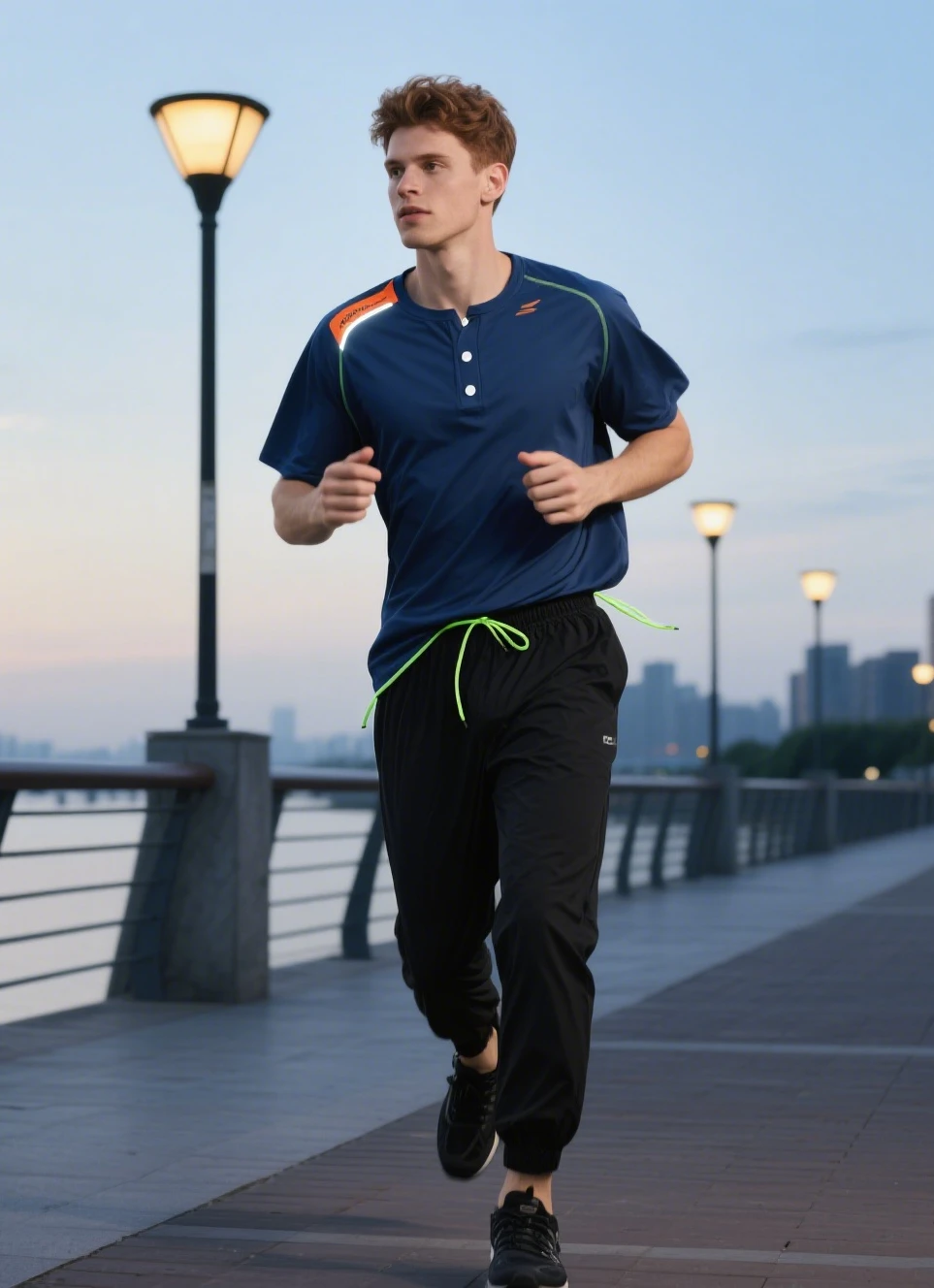
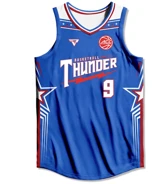
The second filter is the design intent. A single small logo on a performance polo is usually better served by embroidery, which adds a physical mark that reads as premium and survives repeated laundering. A large graphic that wraps around the body, a colour-blocked jersey or a photographic gradient points to sublimation, because only that route can place colour anywhere on the panel without adding weight. Where a programme mixes both, the split is usually by garment type rather than by position on the same garment.
How Does Sublimation Behave on Performance Knit?
The ink bonds into the fibre, not on it.
Because the dye enters the polymer rather than coating it, the print adds no weight and no hand feel, and the graphic moves and stretches with the cloth.
That behaviour is the technique’s principal advantage on sportswear, because a garment worn next to the skin has to stay soft and flexible, and any film or deposit changes how it feels during activity. It also means the print does not crack, peel or flake, because there is no layer to fail. What it can do is fade over time, because the dye is part of the fibre and can be affected by heat, chlorine and aggressive laundering.
The technique also depends on the fabric surface. A smooth, dense knit holds fine detail well, while a textured or open structure allows the print to look slightly softer and less defined, because the surface scatters light unevenly. That interaction is why the same file should be approved on the actual production knit rather than on a stock swatch, and why the wider decoration and finishing context for performance garments is worth reviewing alongside the print itself. LSLONG handles sublimation and the other decoration routes in-house, and the surrounding process is described in the sportswear sublimation and decoration guide.
| Factor | What submation requires | What it cannot do |
|---|---|---|
| Fibre | Polyester or polyamide, usually 100% or near it | Print on cotton-rich or wool-rich cloth |
| Base colour | White or pale fabric for bright, accurate colour | Produce white ink on a dark garment |
| Graphic type | Full-colour, gradients, photographic and all-over designs | Reproduce a raised or textured mark |
| Detail | Fine linework on smooth, dense knits | Guarantee the same sharpness on open or textured structures |
| Laundry | Repeated domestic cycles without fading under normal conditions | Withstand chlorine and high-heat drying indefinitely |
Sublimation Sportswear Printing: Design Rules and Limits
Design for the technique rather than adapting artwork afterwards. Colours that depend on a white base have to be built from a pale fabric, because there is no white ink under them and any colour printed on a dark garment reads as a darker version of the intended shade. Large solid areas in a deep colour on a white base consume more dye and can look slightly uneven where the knit structure varies, so panels are often designed to break up large flats rather than test them.
Three rules prevent most disappointments. Keep fine detail above the resolution the knit can hold, since a knitted surface has a texture of its own that competes with hairline artwork. Design the graphic to respect the seams and the panel boundaries, because artwork that crosses a seam has to align on both sides and on both panels of a pair. And design for the finished size rather than the flat pattern, because a knit stretches when it is worn, and a graphic that is stretched across a chest will read wider than it does on the table. Artwork requirements for team programmes, including file formats and colour handling, are set out in the sublimation artwork requirements guide.
Artwork, Colour and Placement Requirements
Artwork should be prepared in a vector format or at a resolution that suits the print size, with colours defined against a reference the factory can reproduce. Because sublimation colour is affected by the base fabric, the print profile and the pressing conditions, the approval has to happen on the production knit in the production colourway. Approving a colour on a paper proof or a different fabric produces a result that will not match the garment.
Placement follows the garment. On a jersey, the graphic is usually designed around the shoulder, chest and side panels, and the number and name positions are defined from the same reference points as the size chart. On leggings, the graphic wraps a cylinder, which means the artwork has to be designed for a surface that curves in one direction and stretches in two. In both cases the placement should be measured on the finished garment rather than on the flat panel, and colours should be compared against the approved sample under a consistent light source, with instruments such as those from Datacolor used where a numeric comparison is needed.
Durability and Wash Performance
Sublimated print is durable because there is no surface layer to fail, but it is not immune to fading or to the effects of the wash regime. Chlorine, high-temperature drying and repeated abrasion all reduce colour depth over time, and on a garment washed after every session that effect becomes visible within a season. The specification should therefore state the wash cycle and the number of cycles used for testing, and the appearance standard should be approved on a washed print rather than on a fresh one.
Colourfastness and appearance after laundering are assessed through AATCC test methods, and the chemistry side of the process can be documented through the programme routes used for printing chemicals and inks, including OEKO-TEX ECO PASSPORT for auxiliaries and colourants and ZDHC for manufacturing restricted substances. Where a programme sells into markets with strict chemical requirements, the mill and print house documentation is part of the product file rather than a separate environmental exercise.
Cost Per Unit at Different Quantities
Sublimation pricing behaves differently from screen printing. There is little or no setup cost per colour, because the design is printed digitally, so the technique is competitive on small runs and on designs with many colours. The variable cost follows the printed area and the number of panels rather than the colour count, which means a large all-over graphic costs more per garment than a small chest print on the same fabric.
Two decisions then move the number. Designing within standard panel sizes reduces waste, because the print is produced on a paper transfer or directly onto a cut panel and offcuts are consumed with the graphic. Keeping the fabric and the colourway consistent across a range improves the yield and reduces the approval work. Programmes can start from small quantities and ready-to-ship stock is available from 1 piece, so a design can be validated on a short run before a season order. For high-volume teamwear, the comparison with screen printing is worth modelling, since the two routes diverge sharply as quantity rises, and the trade-offs are set out in the decoration comparison published by bluesign partners and the wider industry guidance on the sportswear range.
Sampling, Approval and Common Failures
Approve the print on the production knit, in the production colourway, at the production size. A proof on paper or a print on a different fabric confirms the file but not the result, and the difference between the two is what produces the most common complaint in a sublimation programme: a colour that matched on the proof and reads differently on the garment.
The failures to check for, and their usual causes:
- Colours reading darker than intended, caused by printing on a base colour other than the approved pale fabric.
- Soft or indistinct fine detail, caused by artwork resolution or by a knit structure that scatters the printed surface.
- Misalignment across a seam, caused by artwork designed without regard to panel boundaries.
- Shade variation between panels, caused by differences in fabric or in pressing across the panel.
- Fading after a season, caused by chlorine or high-temperature drying outside the tested regime.
- Colour drift between the approved sample and bulk, caused by substrate or profile changes without re-approval.
What to Put in the Print Specification
The specification should name the fibre and the fabric, because sublimation depends on them, and state the base colour required for the design. It should record the artwork file reference, the print size and placement with measurement points, the colour references and the profile or press conditions if the programme fixes them, and the wash cycle the print must survive with the appearance standard it is compared against.
Add the approval requirement: a print on the production knit, at the production size, washed to the stated cycle and retained as the bulk reference. Keep the care instruction aligned with the tested regime using a recognised symbol system such as GINETEX, so that a customer who follows the label reproduces the conditions the print was tested under. With those lines in place, the decoration is specified as a material decision rather than as a file, and the knowledge hub carries the supporting guides on decoration, fabric and construction.
FAQ
Can sublimation be printed on cotton sportswear?
No, because the dye bonds into synthetic polymer and cotton will not accept it. Cotton-rich garments need a different route, such as screen printing or heat transfer, both of which add a layer to the surface and change the hand feel. If a design depends on full-colour all-over graphics, the garment has to be built from a polyester or polyamide knit, and that decision belongs at the start of the development rather than after the artwork is approved.
Why do sublimated colours look different from the proof?
Because the base fabric is part of the colour. There is no white ink under a sublimated print, so the shade of the knit shows through the graphic, and the pressing conditions and fabric surface affect the final result. Approve the print on the production knit, in the production colourway, at the production size, and compare against that sample rather than against a paper proof when the bulk arrives.
Will a sublimated jersey fade in the wash?
It holds up well under normal domestic laundering because there is no surface layer to crack or peel, but chlorine, high drying temperatures and repeated abrasion reduce colour depth over time. State the wash regime in the specification and test the print through it, then set the care instruction to match. A garment washed after every session will show its limit sooner than one worn occasionally, which is why a tested cycle is more informative than a general claim.
What is the smallest order for a sublimated design?
Because the design is printed digitally, there is no per-colour setup cost, which makes small runs practical. Programmes can start from small quantities, and ready-to-ship stock is available from 1 piece, so a full-colour design can be validated on a short run before a season order. Approve the print on the production fabric at that stage, because the same file on a different knit produces a different result.
Planning a sublimated sportswear programme?
Send the fabric, the artwork, the colourways, the panel sizes and the volume, and LSLONG will confirm the print route, the base fabric requirement and the placement measurements, then produce a printed sample on the production knit for approval. Sublimation, embroidery and transfer decoration are handled in-house in Shenzhen.