

The link between hoodie fabric weight and warmth is looser than most spec sheets admit. A 320 g/m² brushed fleece that feels substantial in one city can be a mild-weather layer in another, and both garments can carry the same weight on the label. Warmth comes from air trapped in the structure, from how much wind the cloth blocks, and from how the garment closes at the neck, cuff and hem. Buyers who treat g/m² as a warmth rating approve the wrong sample for the season, add freight they do not need, or change cloth mid-programme when the first cold-weather test fails.
What Does Weight Actually Tell You About Warmth?
Weight measures mass per area, not heat retention.
A heavier knit usually traps more still air, but fibre, finish, knit density, hood layers, rib recovery and how the garment sits against the body all move the warmth a wearer feels.
Mass per unit area is a controlled measurement, taken under a defined method such as ASTM D3776/D3776M. It tells you how much material is in the cloth and, indirectly, what the garment will weigh and cost to ship. It does not tell you how the cloth behaves in moving air, how quickly it releases moisture, or how much of the wearer’s heat it keeps when the hood is down and the zip is open. Those are comfort properties, and they respond to construction decisions as much as to weight.
The practical rule for a specification-stage buyer is to treat weight as a budget item and warmth as a performance item. Set the weight band first, because it drives fabric cost and freight. Then specify the warmth behaviour you need through loft, finish, hood construction and fit, and confirm it on a finished garment rather than on a swatch card.
Why Two 320 g/m² Hoodies Feel Different
Fibre, finish, knit density and fit all shift the result.
Two cloths of identical mass per square metre can differ in loft, air permeability and moisture regain, and a double-layer hood changes perceived warmth more than a small difference in body cloth weight.
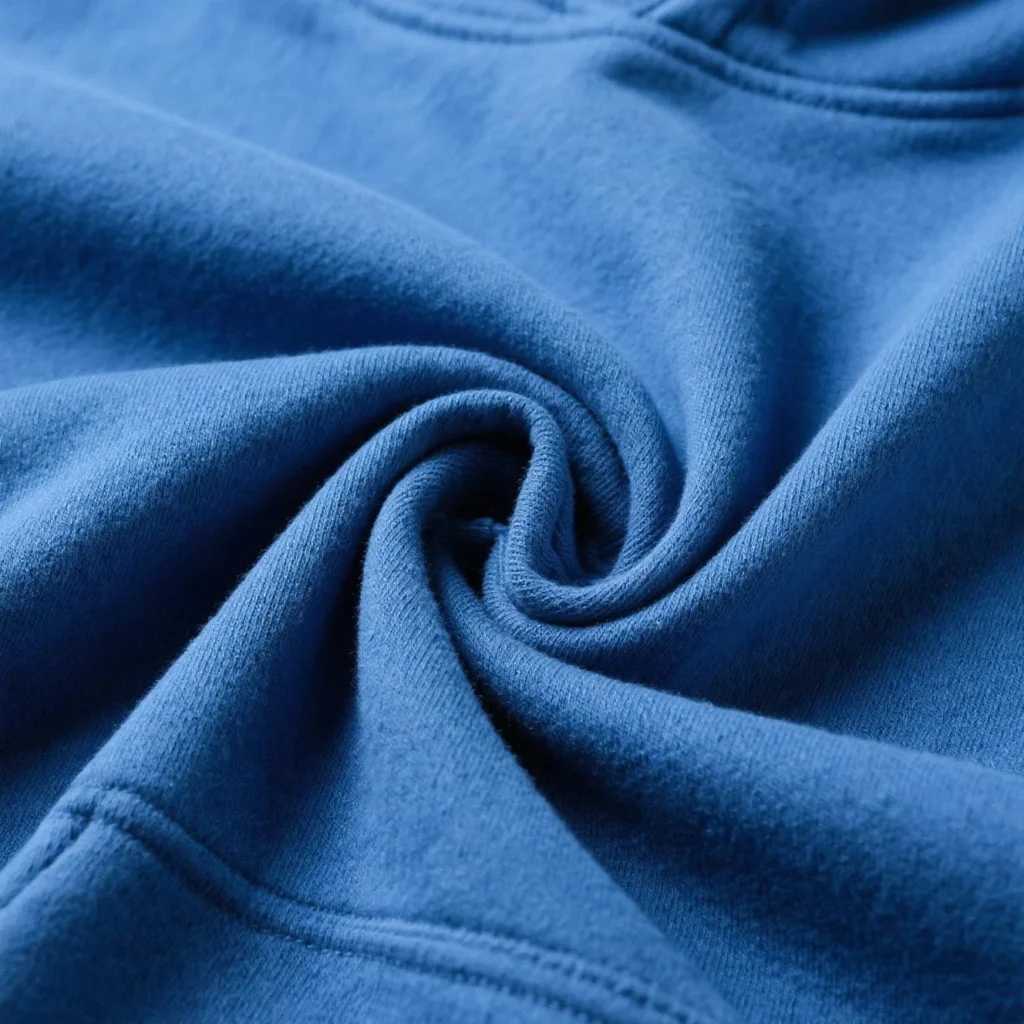
Start with the structure. A loop-back French terry and a brushed fleece can be produced at the same weight and still behave differently: the brushed face traps more still air, while the loop-back face moves air more freely and dries faster. Then look at the fibre mix, because a cotton-rich cloth and a polyester-rich cloth of the same weight handle moisture and drying in different ways, which changes how warm the garment feels during and after activity.
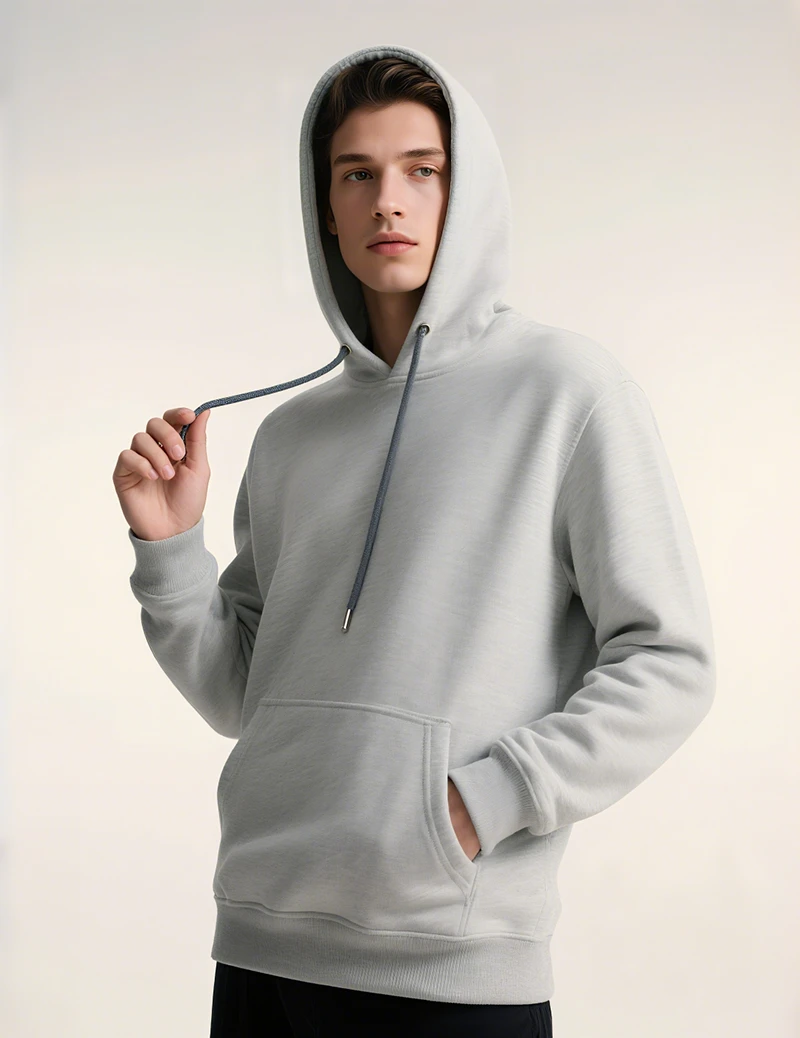
Finish and knit density come next. A compacted, denser knit blocks more air than an open one at the same weight, which matters in exposed conditions; a loftier, more open cloth performs better in still, dry cold. Finally, fit and closure decide how much of that performance reaches the wearer: a hood with a drawcord cinched at the neck, rib cuffs that still recover after a season, and a hem that does not ride up will all read as warmer than the same cloth cut loosely.
Specifying Hoodie Fabric Weight and Warmth by Market and Use
Translate the market into construction decisions rather than into a single number. The table below maps the four situations that cover most hoodie programmes to the specification choices that follow from them, so the weight band, hood construction and finishing route can be agreed in one pass instead of adjusted after the first sample.
| Programme situation | Specification priority | Hood and finish | What to test first |
|---|---|---|---|
| Event and campaign merchandise, worn once or twice | Lower weight band, crisp print surface, low freight per unit | Single-layer hood, self-fabric, light rib | Print detail and hand feel at the chosen weight |
| Retail autumn and spring basics | Mid weight band with a stable, printable face | Single or double hood depending on price point | Dimensional change and surface appearance after washing |
| Core winter retail and layering pieces | Heavier band, napped face, consistent shade across colourways | Double-layer hood, draft-managed neck, tighter cuff recovery | Loft retention and pile appearance after repeated washing |
| Workwear, teamwear and cold-weather uniforms | Heavier band with abrasion-tolerant face and repeatable colour | Double hood, reinforced pockets, durable hardware | Abrasion, colourfastness and shrink behaviour against the stated wash regime |
None of these rows prescribes a number in g/m², and that is deliberate. The weight band has to be set against the buyer’s market, price point and freight model, using the fabric library and past orders as the reference. What the table fixes is the sequence: choose the situation, then the construction that delivers warmth, then the test that proves it. The mechanics of how GSM is measured and compared across programmes sit in the existing hoodie fabric and weight guide, which is the reference page for that topic.
The Variables Weight Cannot Capture
Four properties decide how a hoodie performs in use, and none of them can be read from a weight figure. Air permeability controls how quickly moving air strips warmth from the garment. Moisture handling controls whether the wearer feels damp and cold after activity or a commute. Loft describes how much still air the structure holds and how well it recovers after compression. Fit and closure decide how much of the body the cloth actually protects.
Each one has a specification route:
- Air handling, addressed through knit density, finish and whether the face is napped or looped.
- Moisture behaviour, addressed through the fibre mix and the weight of the cloth relative to the activity it is worn for.
- Loft and compression recovery, addressed through pile height, brushing route and the yarn structure underneath.
- Fit and closure, addressed through hood layers, drawcord, rib recovery at cuff and hem, and the graded measurement chart.
Manufacturers that publish construction and finish data, such as Polartec for fleece fabrics, are useful references for this discussion because they separate the structure of a knit from its marketing name. Use those references to write the specification, then verify the result on the finished garment.
How Do You Verify Warmth and Weight in Production?
Measure weight by method and warmth on the finished garment.
Mass per unit area is checked to ASTM D3776/D3776M on the garment, and comfort claims are supported by testing that reproduces how the garment is worn and washed.
For weight, take the measurement from the finished garment as well as the roll, because rib, hood, pockets and seams all add mass that the roll never shows. For warmth, the defensible approach is thermal and moisture testing on the finished piece. Independent laboratories such as Hohenstein run thermal comfort and physiological testing on textiles and garments, which produces data you can quote in a tender or a product page instead of relying on adjectives.
Where full thermal testing is not proportionate to the order, verify the drivers instead: loft retention after the stated wash cycle, air permeability if the market is windy, and shrinkage measured against your own tolerance. The wash and appearance checks follow AATCC test methods, and abrasion or surface change can be reviewed with ASTM D4966. LSLONG checks these points against the approved reference through its in-house quality process, and fabric compliance for restricted substances can be documented through the OEKO-TEX Standard 100 framework where the programme requires it.
Fit, Layering and the Size Chart Effect
Warmth is partly a sizing decision. An oversized hoodie worn over a mid-layer traps air but allows it to move, while a closer fit with recovered ribbing keeps a still layer next to the body. Neither is better in the abstract; the choice has to match how the garment will be worn. For a market that layers, the size chart should allow room across the chest and shoulder without letting the cuff lose contact with the wrist, because a loose cuff is where most perceived warmth disappears.
Grade the chart deliberately. LSLONG programmes are graded across XS–5XL with a tolerance of ±0.5 cm on the measurement chart, which gives the QC team a workable band while keeping the fit relationship stable from the smallest to the largest size. If the range is extended, the grading increments have to be re-checked rather than scaled up, because sleeve and body lengths do not behave linearly at the extremes.
What Weight Costs: Freight, Storage and Unit Economics
Every gram in the cloth is paid for three times: in the fabric price, in the finished garment weight, and in the volume the garment occupies. Freight is charged on a mix of weight and cube, and a hoodie programme that steps up a weight band usually steps up the carton weight with it. That is why a warmth specification should be written against the market rather than against a preference for a heavy hand feel that the consumer may never notice.
The counterweight is the cost of a poor fit to market. A garment that arrives too light for its season generates returns and reorders in the wrong cloth; a garment that is heavier than it needs to be pays freight on every unit, for the life of the programme. Minimums make it practical to test both: hoodie programmes can start from about 50 pieces per style, and in-stock, ready-to-ship garments are available from 1 piece, so a lightweight test run can validate a weight band before the first bulk order. The cost, MOQ and production guide covers how volume, colourways and finishing interact with unit cost.
Writing the Warmth Requirement into the Tech Pack
A warmth requirement is only useful if the factory can measure it. Write the cloth weight with its test method, the face finish, the hood construction, the rib specification and the wash cycle the garment must survive, then state which of those points will be checked at bulk inspection. Anything that cannot be measured should be replaced with something that can, because an adjective in a tech pack becomes a negotiation at the end of production.
The working list is short:
- Cloth family, face finish and target weight in g/m², with the measurement method named.
- Hood construction: single layer, double layer, lining material and drawcord specification.
- Rib specification for cuff and hem, including recovery expectation after the stated wash cycle.
- Measurement chart with grading and tolerance, plus the fit intent for the target market.
- Wash and care cycle used for testing, including temperature and drying method.
- Abrasion and surface appearance standard, with the approved reference garment retained.
With those six lines agreed, a weight change becomes an engineering decision rather than a guess. The custom hoodie range shows the builds available for each construction, and the knowledge hub carries the supporting guides on fabric, decoration and testing.
FAQ
What does 350 g/m² actually mean on a hoodie?
It is the mass of the fabric per square metre, measured under a defined method rather than judged by hand. Higher figures usually mean more material, a denser or loftier structure, a heavier finished garment and a higher fabric cost per unit. It does not by itself guarantee that the hoodie is warm, because hood layers, rib recovery, air permeability and fit all contribute. Treat the figure as the starting point of the specification, not the conclusion of it.
Is a heavier hoodie always the warmer choice for a cold market?
Not always. In wind, a denser mid-weight knit that blocks air can outperform a looser heavy knit, and a double-layer hood on a mid-weight body often feels warmer than a single-layer hood on a heavy body. Wearing context decides the answer: still, dry cold rewards loft, while exposed and damp conditions reward density and moisture handling. Specify the condition the garment will be worn in, then test the finished piece rather than assuming the heavier cloth wins.
Can warmth be improved without changing the fabric?
Yes, and it is usually the lowest-cost route. Adding a second hood layer, tightening rib recovery at the cuff and hem, adding a drawcord, raising the neckline or reducing the body ease all change how much of the wearer’s heat stays in the garment. Each of those is a pattern or trim decision rather than a fabric purchase, so they can be trialled on a small run before the fabric order is placed, which keeps freight and unit cost stable.
How many pieces do we need to run a cold-weather test order?
A hoodie programme can start from about 50 pieces per style for a production run, while ready-to-ship stock is available from 1 piece when you only need to test fit, weight or finish. For a seasonal validation, a small run in the target colourway lets the team wear and wash the garment under real conditions. Record the wash cycle used and keep the worn sample as the appearance reference for the bulk order.
Planning a seasonal hoodie weight?
Share the market, the season, the target weight band and the decoration plan, and LSLONG will map the specification to a build that can be sampled and tested before commitment. Sampling, decoration and quality control sit in-house in Shenzhen, so construction and testing are reviewed together.