

The zip up vs pullover hoodie question looks like a styling preference and behaves like an engineering change. Adding a closure puts a placket, a tape, a slider and a second set of tolerances into the pattern, and it alters how the garment hangs, how it is decorated and what has to be re-approved on a reorder. Programmes that switch from one build to the other mid-season usually discover the difference when the size chart no longer matches, when the front hem sits unevenly on larger sizes, or when the decoration placement that worked on a closed body reads off-centre on two fronts.
What Changes When a Hoodie Becomes Zip-Through?
The pattern, the trims and the fit tolerances all change.
A zip adds a front opening, tape, a slider and a placket that must align across the graded size range, and it changes how the garment drapes when it is worn open.
Start with the pattern. A pullover body is cut as a closed front, so the only vertical relationship the pattern has to control is the side seam. A zip-through body is cut as two fronts, each with its own length and grain, and the two edges must meet within tolerance at the top and bottom of the opening after the tape is applied. That single change adds a pair of matched pattern pieces, a stabilising step and an extra station in the assembly line.
The commercial consequences follow from the same point. Because the zip-through is worn open, it is judged in two states rather than one, which is why the hem band and the hood seam at the neck deserve more attention on this build. Because the trims are separate components, they also have their own colour matching, their own wash behaviour and their own inspection points. Depending on the programme, LSLONG builds the closure with nylon coil, moulded plastic or metal zips and can finish the tape to match the cloth or to contrast with it.
How Do the Two Builds Differ in Construction?
One is closed at the front, the other is two fronts joined.
A pullover is assembled as a closed body with the hood set into the neckline, while a zip-through build is cut as two fronts, stabilised with tape, and closed by a zip that has to align with the hood seam.
On the pullover, the sequence is straightforward: shoulders, sleeve set, side seams, then the ribbing at cuff and hem, with the hood attached around the neckline and the pocket applied to the front. Print and embroidery placement are referenced from the centre of one continuous front panel, which keeps the artwork centred by definition.
The zip-through sequence is longer. Each front is taped or fused along its opening edge to stop the knit from rolling or stretching, then the zip is attached and topstitched on both sides. The hood is then joined across the front edges rather than around a closed neckline, which makes the neck junction the most demanding point of the whole garment. After that the build continues like the pullover: sleeve set, side seams, cuff and hem ribbing, pocket, hardware. Thread choice matters here. Coats publishes thread and seam guidance for knit and zip applications, and a programme that specifies thread elongation against the cloth will see fewer popped seams at the placket than one that buys thread on price alone.
Zip Up vs Pullover Hoodie: Which Build Fits Which Programme?
Match the closure to how the garment will be worn.
Open-front builds suit layering, easy on-off in workwear and broad climate range, while pullover builds favour print-led retail, warmer markets and a lower trim count.
| Decision point | Pullover hoodie | Zip-up hoodie |
|---|---|---|
| Trim package | Rib, tape and drawcord only | Adds tape, zip, slider, puller and stop hardware |
| Decoration surface | One continuous front panel, centred artwork by default | Two fronts, so placement is set from the centre line of the opening |
| Wearing context | Layer once and commit, typical of colder markets | Layer and ventilate, typical for uniforms, travel and changeable climates |
| Fit judgement | Judged closed, so ease is the main variable | Judged open and closed, so hem and front alignment become visible |
| Inspection load | Seams, rib, hood and pocket | Adds zip cycling, tape alignment, slider function and stop security |
| Reorder sensitivity | Colour and shrink control | Colour, shrink control plus component availability on tape and slider |
Neither column is better in the abstract. The custom hoodie range covers pullover, zip-up, quarter-zip, oversized, cropped and fitted builds, which makes the comparison practical rather than theoretical: a buyer can sample one body in both closures before deciding, using the same cloth and the same size chart as the reference.
Zip Specification: Length, Gauge, Tape and Slider
The zip decides how the front behaves, so it is specified as a system rather than as a component. Length, gauge, tape width, tape colour, slider type and the finish at both ends all interact with the cloth weight and with the hood junction. A coil zip on a heavy brushed fleece needs a tape that can stabilise the opening under load, while the same zip on a light terry will look heavy and pull the front out of line.
Write these points into the specification rather than leaving them to the sample room:
- Zip type and gauge, chosen against the cloth weight and the intended use.
- Finished length in cm, measured between defined points so the sample and the bulk agree.
- Tape width and colour, including whether it is dyed to match the cloth or supplied as a contrast.
- Slider and puller style, plus the metal or plastic finish and any branding on the puller.
- Top and bottom stop treatment, and whether the opening is fully separating or closed at the base.
- Knit stabilisation method behind the tape, which is what keeps the opening from waving after washing.
Two components in the build are frequently underestimated. Rib elastane governs how the cuff and hem recover, and the elastane specification on a zip-through has to hold against the extra weight of an open front, so a fibre reference such as LYCRA is useful when the recovery target is written down. Interlining and tape behind the placket come from suppliers such as Freudenberg Performance Materials, and the specification should state whether the tape is fusible, stitched or both.
Cost, Minimum Quantity and Development Timeline
The closure adds cost in three places: the trim package, the sewing time and the development rounds. Trims are purchased components, so every colourway carries its own tape and zip requirement and its own minimum. Sewing time rises because the placket is a separate assembly with two topstitch runs, and the hood junction takes longer to set than a closed neckline. Development time rises because the build needs its own fit approval before it can be graded.
Those costs are manageable when they are planned. Two points keep a zip-through programme efficient: standardise the tape and slider across colourways wherever the design allows, and keep the zip length consistent across the size range unless the pattern genuinely requires a shorter opening on smaller sizes. Minimums are less of a barrier than buyers expect, since hoodie programmes can start from about 50 pieces per style, and in-stock, ready-to-ship garments are available from 1 piece for a fit or market test. The cost, MOQ and production guide covers how trims, colourways and volume interact with unit cost.
Fit, Ease and Grading Differences
The two builds cannot share a size chart without checking it. A pullover is measured as a closed garment, so body width and length are single values. A zip-through is measured with the front closed as well, but the opening introduces a new risk: the two fronts can differ in length once the tape is applied, especially at the bottom of the opening on the larger sizes, and that error is visible on the hanger before it is visible on the body.
Control it in the pattern and in the inspection. The front edges should be cut as a matched pair with the same grain direction, the tape applied under controlled tension, and the hem band joined so the placket meets the rib at a fixed point across the graded range. LSLONG programmes are graded across XS–5XL with a tolerance of ±0.5 cm on the measurement chart, and on a zip-through the front length difference between the two panels deserves its own line in that chart, because a small asymmetry reads as a defect even when the overall measurements pass.
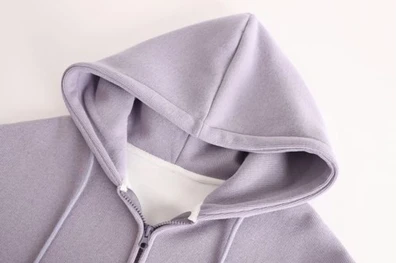
Quality Checks for Zip-Through Builds
A zip-through adds a set of mechanical checks to the checks the garment already carries. The zip is the component most likely to fail in service, and it is also the one most easily inspected at the end of the line, which makes it a cost-effective place to add inspection time. The wash test matters as much as the visual check, because a tape that shrinks differently from the cloth will pull the front out of shape after the first commercial laundering.
Add these points to the inspection plan:
- Zip cycling in both directions across the full length, with the slider tension recorded as pass or fail rather than described.
- Top and bottom stop security, plus a check that the slider does not travel past its intended limit under load.
- Tape alignment and shade against the cloth, including the dyed-to-match condition across every colourway.
- Front length and hem band alignment, measured on the closed garment against the graded chart.
- Neckline junction quality where the hood meets the tape, checked for puckering and for stitch density.
- Appearance and dimensional change after the stated wash cycle, with the zip and tape reassessed on the washed sample.
Appearance and shrinkage checks follow the methods published by AATCC, and mass per unit area on the finished garment is verified to ASTM D3776/D3776M rather than taken from the mill ticket. LSLONG runs these checks against the approved reference through its in-house quality process.

What to Write into the Tech Pack
The tech pack for a zip-through is a superset of the pullover pack, and the extra lines are almost all about the opening. Write the closure as a system: type and gauge, finished length with its measurement points, tape specification, slider and puller, stop treatment and the alignment tolerance between the two fronts. Then write the care requirement, because heat and drying behaviour affects tape and knit differently.
The care instruction itself should follow a recognised symbol system so the end user reads it correctly in every market, and GINETEX maintains the international care labelling symbols that most retail programmes reference. Alongside that, record the wash cycle used for testing, the tolerance for dimensional change and the approved reference garment for each colourway.
Keep the rest of the pack identical between the two builds wherever possible: cloth family, weight with method, hood construction, pocket type, rib specification, measurement chart and packing instruction. That way the closure is the only variable, which makes the comparison between pullover and zip-through a genuine test of the opening rather than of two different garments. The LSLONG knowledge hub holds the supporting guides on construction, decoration and testing for both builds.
FAQ
Can a pullover hoodie pattern be converted into a zip-up?
It can, but not by cutting the front panel down the middle. The conversion needs a revised front pattern with an added allowance for the tape and zip, a stabilised placket, a re-cut hood with a front opening, and a new fit approval before grading. Expect a fresh sample round rather than an adjustment to the existing sample, because front length alignment and neck junction behaviour change on every size. Treat the conversion as a new development and budget accordingly.
Do zip-up hoodies need different wash testing?
They need the same tests plus component checks. Shrinkage, surface appearance and colourfastness are assessed as they are on any knit garment, then the zip, tape and slider are re-examined on the washed sample to confirm the slider still runs, the stops still hold and the tape has not shrunk away from the cloth. A tape that shrinks differently from the body will bow the front edge, which shows up as a fit defect even when the measurements themselves pass.
Which build is easier to keep consistent on reorder?
The pullover has fewer variables, because it has no purchased components to match beyond rib and drawcord. A zip-through adds tape and slider supply to the colour and shrink controls, so consistency depends on keeping the same component specification and the same supplier across orders. Where a programme needs both builds, approve them together with a shared cloth and colour reference, then keep the reference garments for each closure separately.
What is the smallest order for a zip-up hoodie trial?
A hoodie programme can start from about 50 pieces per style for a production run, while ready-to-ship stock is available from 1 piece when you only need to test fit, closure feel or decoration placement. A trial in the target colourway is the practical way to check the placket, the neck junction and the hood behaviour before a bulk commitment, and the approved trial garment then becomes the reference for the bulk inspection.
Comparing closures for a hoodie programme?
Send the closure you are considering, the cloth and weight, the colourway count and the target market, and LSLONG will confirm the construction, the trim specification and the sampling route. Development, decoration and quality control are handled in-house in Shenzhen, so both builds can be sampled against the same cloth and size chart.