

A corporate polo uniform programme is a supply project rather than a garment purchase. It has to cover a workforce whose members range across several sizes and shapes, it has to arrive on a date that is tied to a rebranding, an event or a contract start, and it has to stay consistent for years while people join and leave. The garments are simple; the administration is what decides whether the programme succeeds. Buyers who treat it as an order rather than a programme usually discover the difference when the first replacement requests arrive with no matching stock to fill them.
What Does a Corporate Uniform Programme Have to Deliver?
Fit across a workforce, with reorderable stock.
The programme has to deliver a size range that covers the workforce, a shade that repeats across deliveries, a decoration that survives the company laundry, and a supply route that fills replacement requests.
Start with coverage. A workforce range is not the same as a retail size run: it usually needs a wider spread at the larger sizes, an accurate measurement route for remote staff, and a decision about how far the range extends before garments are made specially. The practical solution is a core range with a defined measurement chart, plus a clear policy for special sizes that can be produced separately rather than forcing the core chart to cover everyone.
Then the commercial requirement: continuity. A uniform is worn by a team that changes, so the programme has to be able to supply a single garment in an existing specification months or years after the original order. That means holding cloth or reserving a colour reference, keeping the pattern and decoration files under version control, and agreeing in advance what happens when a colourway is discontinued. Those three items are what convert a one-off order into a programme.
Sizing and Fit Strategy for a Workforce Range
Fit strategy begins with how staff will be measured. Some organisations measure everyone on site, others ask staff to submit sizes, and others use a sample kit that is tried on and returned. The route matters, because self-reported sizes produce more exchanges than a physical try-on, and the exchange rate is the single largest hidden cost in a uniform rollout.
Whichever route is used, the size chart has to be stable and the grading sensible across the range. LSLONG grades polo programmes across XS–5XL with a tolerance of ±0.5 cm on the measurement chart, which supports a workforce range while keeping the fit relationship between sizes intact. Where a programme includes both men’s and women’s cuts, treat them as two charts rather than one, because a shared chart produces fit that satisfies neither group. Decide in advance how many exchanges the programme expects, and budget for them, rather than treating each one as a failure.
Fabric and Construction Specification for Uniform Wear
Uniform wear is harder on a polo than retail wear, so the specification should be built around the wash regime and the working environment. Pique remains the standard choice for corporate programmes because the structure holds shape, hides creases and supports a collar through repeated laundering, while a blend with a proportion of polyester improves colour retention and drying. Where staff work outdoors, the specification moves toward performance knits with moisture management, as set out in the field-work guidance for performance polos.
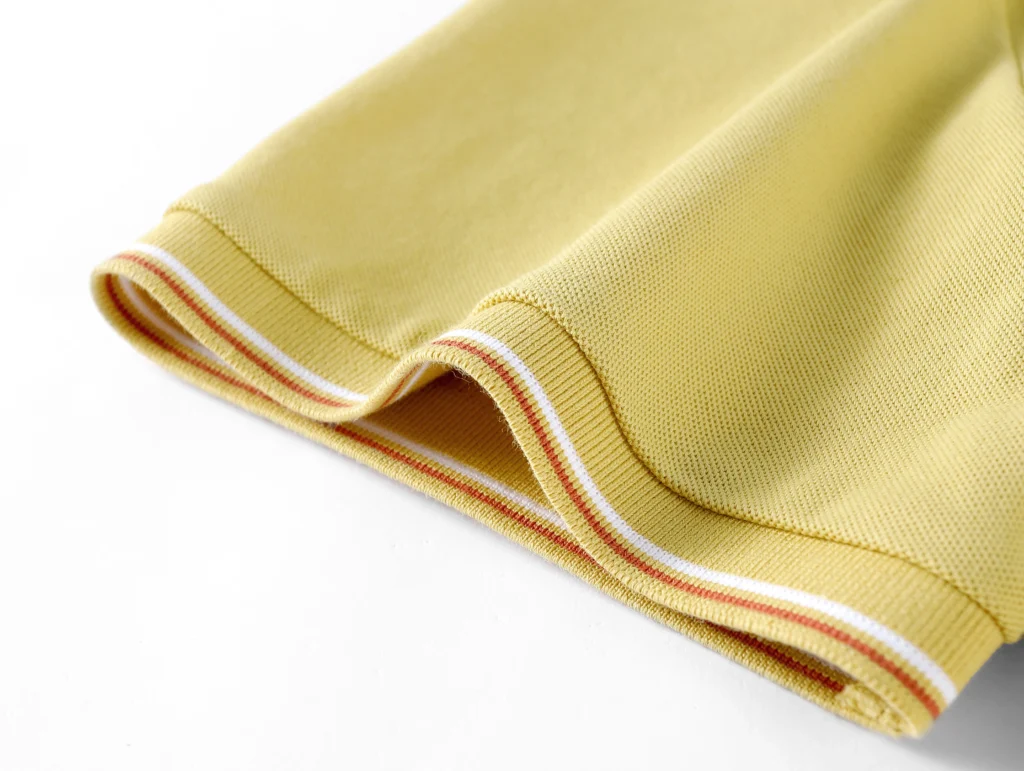
Construction details decide how the garment ages. A ribbed cuff holds the sleeve; a well-supported collar keeps the uniform looking maintained; a placket with a proper interlining keeps its edge; and side vents or a shaped hem stop the garment riding up when the wearer reaches or drives. Colourfastness and appearance after laundering matter more here than in retail, and the chosen wash regime should be confirmed with the employer’s laundry before the specification is locked.
Sampling, Approval and Rollout Sequence
A uniform rollout should be sequenced so that the decisions that everything else depends on are made first. Approve the fabric and the colour, then the construction, then the decoration, then the size chart, and only then the volume order. Where a programme includes several garment types in one corporate identity, approve them as a set, because a polo, a shirt and a jacket that are approved separately frequently arrive in three slightly different shades.
Rollout then follows a practical order: produce a wearer trial in the core sizes, confirm the measurement chart and the size selection process on real staff, correct the distribution list, and only then release the full order. A trial group of ten to twenty wearers across the size range exposes the two problems that cost the most to fix later: a chart that does not cover the population, and a decoration position that looks wrong on a large size. The governance for multi-garment programmes is covered in the corporate and team polo programme guide.
Quality Control and Inspection Points
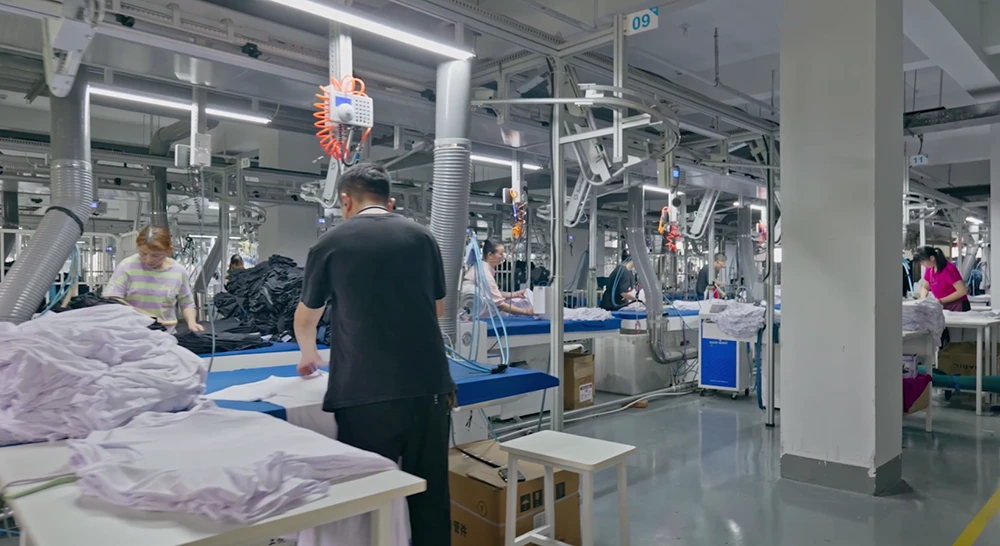
Inspect a uniform programme against the chart and the reference, at the sizes the workforce actually uses. Where a retail order might be assessed on overall appearance, a uniform programme has to be checked for the details that staff notice: a collar that stands the same way on every garment, a placket that closes cleanly, a shade that matches across the order, and a decoration positioned identically on every size in the range.
The inspection list for a corporate programme should include:
- Measurement chart checked at the smallest, middle and largest sizes, including the extended sizes.
- Shade consistency across the whole order, not only between two garments.
- Collar, cuff and placket condition after the employer’s stated wash cycle, assessed through AATCC test methods.
- Decoration position and size verified against the approved sample on each size.
- Abrasion and surface condition on high-wear areas such as the collar edge and cuff, reviewed with ASTM D4966 where a result is needed.
- Weight and finish of the cloth verified to ASTM D3776/D3776M on the finished garment.
Where the programme includes individual packing for distribution to named staff, the packing specification becomes an inspection item in its own right, including bag labelling and size marking. Social compliance documentation is frequently requested in corporate tenders, and audit schemes such as amfori provide a recognised route, with restricted substance documentation available through the OEKO-TEX Standard 100 framework for the fabric and trims.
Reorder and Continuity Planning
Agree the stock strategy before the first order ships, because it changes what the programme buys. Reserving cloth and trims for the programme term protects the shade and the specification but commits budget to material that may never be used, while holding finished garments per size protects the delivery date and consumes storage. In practice, most programmes combine the two: reserve the cloth for the core colourway, hold a defined number of finished garments in the most frequently requested sizes, and treat colourway changes as a formal revision of the programme rather than as a routine request.
Continuity is the part of a uniform programme that determines its cost over time. Replacement garments arrive one at a time, in a specification that must match what existing staff are wearing, which means the programe needs a stock strategy rather than a repeat-order process. Two approaches work: reserve cloth and trim in the original colour at the start of the programme, or hold a defined number of finished garments per size as replacement stock.
Either way, the references have to be complete and stable: pattern version, measurement chart, cloth specification with weight and finish, colour reference with its approved Pantone number, decoration file and its sew-out, and the packing specification. Where the programme runs for several years, re-approve the shade against the stored reference before each replenishment run, and keep a reference garment in each colourway sealed and away from daylight. Record what happens if the cloth is discontinued, and agree a substitute process in advance rather than during a stockout.
Corporate Polo Uniform Budget and Volume Considerations
Budget the replacement stream at the same time as the rollout. Replacements are the cost that grows after the programme has been approved, and they are driven by staff turnover, garment wear and size changes rather than by purchasing decisions. Estimating an annual replacement quantity per hundred wearers, and pricing it at the programme’s unit cost, turns an unpredictable request into a planned purchase. It also gives the supplier a volume to plan cloth around, which is what keeps replacement garments matching the original delivery.
Budget the programme in four parts rather than one. The garment cost is the visible part; sampling and development is the fixed part; decoration setup and screens or digitising sit between the two; and the administration of sizing, distribution and exchanges is the part most often omitted. On a first rollout, administration can exceed the value of the samples by a wide margin, and on a programme with high staff turnover it becomes the recurring cost that decides whether the uniform policy is sustainable.
Volume helps differently in each part. Garment and decoration costs fall as quantity rises, sampling is a fixed cost that reduces per unit once the volume is known, and administration costs are largely independent of order size. That structure favours consolidating the season’s requirement into fewer, larger orders rather than releasing small batches, provided storage is available. Polo programmes can start from about 50 pieces per style, and in-stock polo shirts are available from 1 piece for trial and replacement, which allows a programme to be piloted before the full rollout. Packaging for individual distribution is covered in the branded polo packaging guide.
What to Put in the Programme Brief
The brief should read like a specification for a service, not a description of a garment. Record the workforce size range and how staff will be measured; the number of garments, colourways and decoration positions; the wash regime the garments will meet; the delivery date and how the order will be distributed; the replacement policy; and the reference material that will be kept for the life of the programme.
Add the governance items that prevent disputes later: who approves a shade, how a size exchange is handled, what happens if a colourway is discontinued, and where the decoration file is stored. A brief that answers those questions can be quoted accurately, and a supplier can plan cloth and decoration around it rather than reacting to each replenishment. LSLONG produces corporate and team polo programmes in Shenzhen with construction, decoration, packing and quality control under one roof, which keeps the sample, the bulk order and the replacements inside the same specification, and the knowledge hub carries the supporting guides on fabric, construction and testing.
FAQ
How should staff sizes be collected for a uniform rollout?
A physical try-on produces fewer exchanges than self-reported sizes, whether it is done on site or through a sample kit circulated to departments. If self-reporting is the only practical route, issue a clear measurement guide with the chest, waist and length instructions and expect a defined exchange allowance. Whichever method is used, keep the measurement chart stable and record the size each person received, because that record is what makes the next replacement accurate.
How long should a uniform programme keep the same specification?
For as long as the uniform is in service, which is typically several years. Keeping the specification means keeping the pattern version, the cloth reference, the colour reference, the decoration file and the size chart together, and re-approving a replenishment run against a stored reference rather than against the previous delivery. Where a cloth or colourway is discontinued, an agreed substitute process avoids a stockout and stops individual departments sourcing their own replacement garments.
Can one polo programme serve both office and field staff?
It can share an identity without sharing a construction. Office and field staff usually need different fabric behaviour, because field work requires moisture management, faster drying and abrasion tolerance. The practical approach is one colour and decoration standard applied to two specifications, so the range reads as one uniform while each group gets a garment suited to its working conditions. Approve the two specifications as a set to keep the shade consistent across both.
What documentation is usually requested for a corporate uniform tender?
Corporate tenders commonly ask for certification with scope, audit reports, restricted substance documentation and previous programme references. Have the management-system certificates ready with the site and product line they cover, a current social compliance audit where the market or policy requires it, and material documentation for the fabric and trims through a recognised framework. Keep the documents tied to the specific order and colourways, because a certificate issued for one site or material does not automatically cover another.
Planning a corporate uniform rollout?
Send the workforce size range, the number of garments, the colourways, the decoration positions, the wash regime and the delivery date, and LSLONG will confirm the fabric and construction, the sampling sequence and the replacement route, then produce a wearer trial before the full order is released. Production, decoration and packing are handled in-house in Shenzhen.