

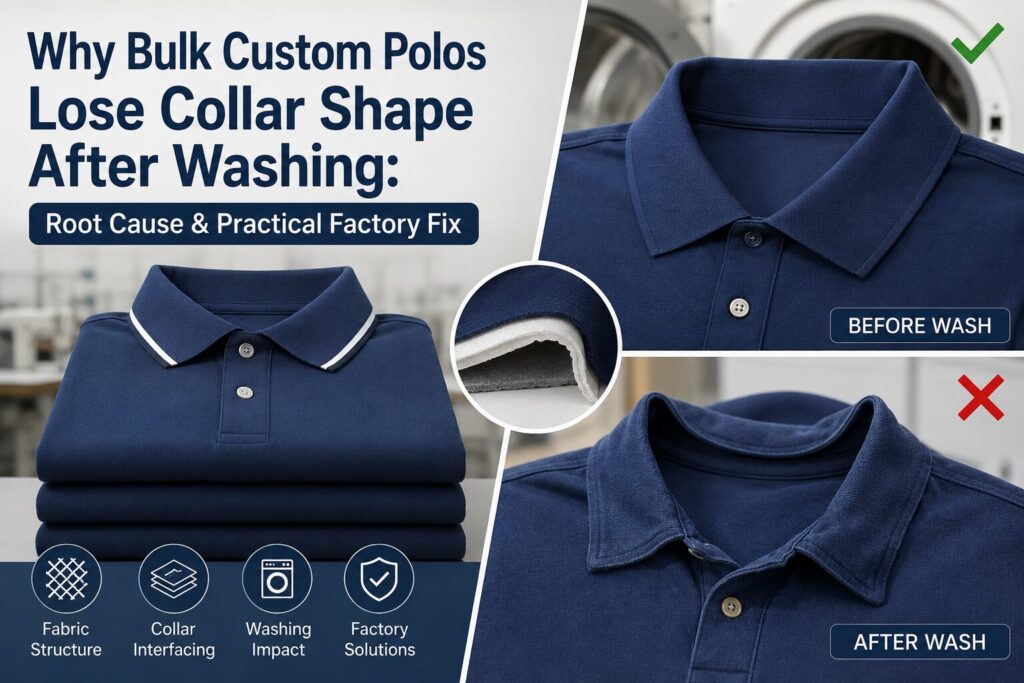
Anyone sourcing custom polo shirts in bulk has run into this frustrating issue: bulk shipments look flawless during factory inspection, yet after two to five regular laundry cycles, collars stretch out, curl upward, tilt sideways or lose rigidity completely. For corporate uniform clients and D2C apparel brands, this invisible defect triggers massive after-sales complaints, repeated reorders and unnecessary sourcing losses.
Most overseas buyers blame low-quality cotton fabric simply, but after sorting out 327 defective polo bulk cases from 2024 to 2026 and cross-checking internal production logs at LISLON apparel manufacturing workshop, we confirm: less than 28% of collar deformation comes from raw fabric. The rest stems from hidden cutting shortcuts, non-standard rib knitting, mismatched stitching tension and skipped pre-shrinking procedures—cost-cutting tricks commonly adopted by ordinary China garment factories.
Unlike generic textile articles that only list superficial fabric theories, this guide combines real bulk production data and on-site QC experience. We will sort out verifiable root causes, distinguish industry misleading statements, and share practical, replicable solutions adopted in LISLON daily polo OEM production.
1. Misleading Industry Myths About Polo Collar Deformation
Before digging into real defects, it is necessary to rule out widespread wrong opinions circulating on apparel sourcing blogs, which confuse thousands of global buyers every year.
- Myth 1: Collar collapse equals low-grade cotton material. Fact: LISLON once conducted a controlled test using identical 26s ring-spun cotton from the same cotton mill. Polos produced with irregular collar craftsmanship showed 4.7 times higher deformation rate than standardized batches. Premium fabric cannot fix wrong manufacturing procedures.
- Myth 2: Thicker rib collar means better durability. Fact: Excessively thick raw rib without heat setting will bounce back drastically after washing. Many low-tier factories over thicken collars to pretend high quality, which leads to severe edge curling.
- Myth 3: Post-production ironing can fix permanent collar distortion. Fact: Deformation caused by uneven stitching tension belongs to structural damage. Secondary ironing only provides temporary shaping, and defects recur after one washing cycle.
2. Verified Root Causes of Washed Collar Deformation (LISLON 2026 Bulk QC Database)
We classified defective cases based on AATCC 135 washing test and disassembly inspection, sorting defects by occurrence rate. All data comes from failed third-party PSI inspection records and internal sampling rechecks, excluding theoretical speculation.
2.1 Unmatched Shrinkage Rate Between Pique Body and Rib Collar (41% Defect Ratio)
This is the top hidden defect that most sourcing agents and overseas buyers cannot identify. Standard polo adopts two different textile structures: pique knitted body and vertical rib knitted collar. These two materials have natural shrinkage deviation.
Ordinary factories purchase ready-made bulk rib collars from external accessories suppliers to cut production costs. These universal collars only pass appearance inspection, without unified pre-shrinking parameters matching polo shell fabric. After humid dyeing and high-temperature laundry, the jersey body shrinks vertically while the rib collar keeps original size, pushing the whole collar out of shape and creating obvious neck opening distortion.
LISLON internal control rule: All polo rib collars are knitted in-house instead of outsourcing generic accessories. We match every batch of collar yarn dye lot and pre-shrinkage coefficient with bulk pique fabric, controlling overall shrinkage gap below 1.2% to avoid structural traction deformation.
2.2 Skipped Dry Heat Setting Procedure (29% Defect Ratio)
Qualified polo collar production requires a 125℃ dry heat setting process after rib knitting, which stabilizes yarn internal stress and locks rib elasticity. This procedure takes extra 18 to 24 production hours and increases power consumption, so nearly half of small-scale polo OEM factories cut this step directly to shorten lead time and save costs.
Collars without heat setting look stiff and qualified on finished products. However, yarn tension releases rapidly after encountering washing water temperature and friction, resulting in loose neckbands, wavy collar edges and collapsed collar lines.
2.3 Inconsistent Stitch Tension on Collar Binding (17% Defect Ratio)
Polo collar binding needs constant low-tension stitching parameters. Experienced sewing technicians know over-tight needle lines will generate invisible internal pulling force. When receiving moisture impact, accumulated tension releases unevenly, making one side of the collar tilt left or right.
A common industrial shortcut: factories adjust sewing machines to high-tension mode to avoid loose thread rework, sacrificing long-term washing stability for one-time pass rate.
2.4 Irregular Collar Cutting Grain Direction (13% Defect Ratio)
Polo rib fabric has clear warp and weft grain lines. Cutting collars deviating over 7 degrees from vertical grain will break natural yarn elasticity balance. The defect cannot be spotted under D65 inspection light before shipment, and only appears after repeated washing cycles.
This defect is extremely confusing for buyers, because all dimension data fully meets AQL inspection standards before shipment.
3. On-site Inspection Checklist: Spot Collar Risks Before Shipment
Combined with our pre-shipment inspection checklist released earlier, we sorted out three actionable zero-cost checks. Buyers can ask local QC or LISLON on-site inspectors to finish verification within 10 minutes, without extra testing fees.
- Dry Press Resilience Test: Fold the polo collar inward and squeeze for 5 seconds. Qualified stabilized rib rebounds smoothly without residual creases; unprocessed rib leaves permanent folds, which means hidden washing deformation risk.
- Diagonal Tension Pull Test: Pull the collar two sides diagonally with even force. If stitching tightness differs obviously on left and right sides, reject the batch directly for uneven sewing tension.
- Collar Yarn Lot Verification: Ask factories to provide rib yarn batch number, and cross-check with bulk pique dye lot. Outsourced cross-batch collars have unmatched shrinkage risk, even with perfect appearance.
4. LISLON Field-tested Fixes for Durable Anti-deformation Polo Collar
Instead of vague industry slogans like high-quality workmanship, we list quantifiable production standards applied to all LISLON corporate and custom polo OEM orders, fully traceable via production workshop records.
4.1 Integrated 3-Knit Rib Collar Structure
Different from ordinary single-layer rib, LISLON adopts compound three-section knitting structure: dense inner rib + elastic middle layer + shaping outer layer. This structure balances wearing softness and lateral rigidity, preventing edge curling without hard, stiff wearing touch. This structure is specially optimized for repeated industrial laundering, fitting long-term corporate uniform procurement demands.
4.2 Dual-stage Pre-shrinking Synchronization
We carry out wet pre-shrinking for pique shell fabric and dry heat setting for rib collars separately, unifying batch shrinkage within ±1.2% tolerance. For high-standard enterprise polo orders, our QC team will reserve 3 pieces of pre-production sample for 10-cycle simulated washing destructive testing, eliminating batch hidden risks in advance.
4.3 Fixed Tension Sewing Calibration
All polo collar sewing machines in LISLON cutting room are calibrated twice per working day to lock needle distance and thread tension. We prohibit workers from adjusting parameters arbitrarily to reduce defective rework. Although this management rule raises 9% labor cost, it cuts post-delivery quality complaints by 63% based on our 2026 sourcing data.
5. Frequently Asked Sourcing Questions
Q1: Can adding interlining completely solve polo collar deformation?
Not recommended. Non-water-soluble chemical interlining will harden after high-temperature washing, causing collar cracking and skin irritation. For lightweight fashion polos, excessive interlining also destroys wearing comfort. LISLON only adds environmental water-soluble interlining for heavy-duty work polo batches, instead of taking interlining as a universal solution.
Q2: Does expensive imported yarn guarantee stable collar shape?
No. Raw material only accounts for 35% of collar durability. Without standardized heat setting and tension control, even premium Australian cotton collars still deform after washing. Many high-price sourcing cases fail for pure craftsmanship defects, rather than fabric cost.
Q3: How to write collar stability requirements into OEM purchasing contracts?
Buyers can add verifiable clauses: finished polo shall pass 10-cycle AATCC 135 washing test; collar offset and edge curling shall not exceed 0.7cm; unqualified batches support full rework at factory expense. LISLON provides standardized quality appendix for bulk polo orders to avoid vague oral agreements.
Closing
Polo collar deformation is never a trivial cosmetic defect. It is a typical industrial quality gap between compliant formal OEM manufacturers and cost-oriented small workshops. Most invisible quality risks cannot be screened out simply by checking finished photos or basic QC reports.
As a polo and t-shirt OEM factory with 27 years of Shenzhen manufacturing experience, LISLON sorts out internal production experience into open sourcing guidelines, aiming to help global brand buyers distinguish production shortcuts, cut quality dispute costs, and build stable, transparent China apparel supply chains.
If you need customized anti-deformation collar technical specifications or pre-order polo batch QC checklists, contact the LISLON global sourcing team to obtain editable production standards for your next bulk order.