

T-shirt shrinkage is one of the few quality issues a customer can measure. Body length, chest width, sleeve length and neckband width all move in laundering, and the movement is visible immediately because the garment either still fits or it does not. Programme buyers who treat shrinkage as a label claim rather than a tested limit usually meet the problem in return data, several weeks after the bulk order has shipped. The practical control is to choose a shrinkage route, write a tolerance with a method, and test the finished garment.
What Does Shrinkage Control Change Downstream?
It decides whether the size chart survives washing.
Shrinkage control affects cloth selection, finishing route, pattern allowance, wash testing and reorder consistency, because the garment has to measure correctly after the wearer has washed it.
The measurement side is well understood. Knitted cotton moves in laundering, more along one axis than the other, and the pattern allowance has to absorb that movement so that the finished garment lands inside the chart after washing. A garment that measures correctly at delivery and drifts afterwards fails the customer even if the production inspection passed, because the customer only sees the post-wash state.
The commercial side follows. A programme with a loose tolerance generates exchanges and unhappy reviews; a programme with a tolerance tighter than its market needs pays for a finishing process the customer never notices. Shrinkage also affects the components attached to the garment: the neckband, the hem and the sleeve opening all move at different rates from the body, so a single figure for the garment is not enough to describe the result.
How Do the Main Shrinkage Routes Differ?
By compacting, resin finishing or garment processing.
Mechanical compacting reduces residual shrinkage in the cloth, chemical finishing stabilises the structure, and garment washing moves the fabric before the customer receives it.
Compacting is the standard route for cotton jersey. The cloth passes through rollers that compress it lengthwise, which reduces how much it will contract later without adding chemistry and keeps the hand feel natural. Pre-shrinking applies the same principle at a different stage, and the two are frequently combined. Neither removes movement entirely, which is why the residual figure still has to be measured rather than assumed.
Chemical or resin finishing stabilises the structure more firmly and suits programmes with a tight tolerance, at the cost of a slightly firmer hand and a chemistry package that has to be documented. Garment washing takes the opposite approach, processing the finished shirt so that most of the movement happens before delivery. That produces a stable garment with a softer hand, and it is the route behind washed and vintage looks. The trade-off is cost and process control, because each garment passes through a separate operation and the consistency of that operation has to be managed. The wider specification and testing context for t-shirts is set out in the shrinkage and dimensional stability guide.
| Route | How it works | Effect on the garment | Where it fits | What to watch |
|---|---|---|---|---|
| Compacting | Cloth compressed mechanically before cutting | Reduced residual movement, natural hand | Most cotton jersey programmes | Relaxation time before cutting still affects the result |
| Resin finishing | Structure stabilised with a finishing chemistry | Tight dimensional control, firmer hand | Programmes with a strict tolerance | Chemistry documentation and hand feel approval |
| Garment wash | Finished shirt processed before packing | Movement happens before delivery, softer hand | Washed looks and premium basics | Batch consistency and added handling cost |
| No treatment | Cloth cut without stabilising | Full movement appears after the first home wash | Programmes accepting a relaxed tolerance | The care label becomes the only control |
T-Shirt Shrinkage: Setting the Tolerance and the Test Cycle
Set the test before the tolerance. The test defines temperature, chemistry and drying method, and each of those changes the result, so a tolerance quoted without a method cannot be verified. Dimensional change on the finished garment is measured through AATCC test methods, with mass per unit area verified to ASTM D3776/D3776M and knit stretch and recovery assessed under ASTM D2594. Where a programme needs independent verification, laboratories such as Hohenstein test textiles and garments against recognised methods.
Then express the tolerance twice: as a percentage of the panel measurement, so the pattern team can build the allowance into the cut, and as centimetre values on the inspection sheet, so the quality team can measure the finished garment. LSLONG t-shirt programmes are graded across XS–5XL with a tolerance of ±0.5 cm on the measurement chart, and the shrinkage limit should reference that same chart rather than a separate document. Where a programme runs against a retailer’s specification, quote the method and the cycle alongside the tolerance, since a tolerance without a method is not enforceable.

Body, Sleeve and Neckband Behaviour After Washing
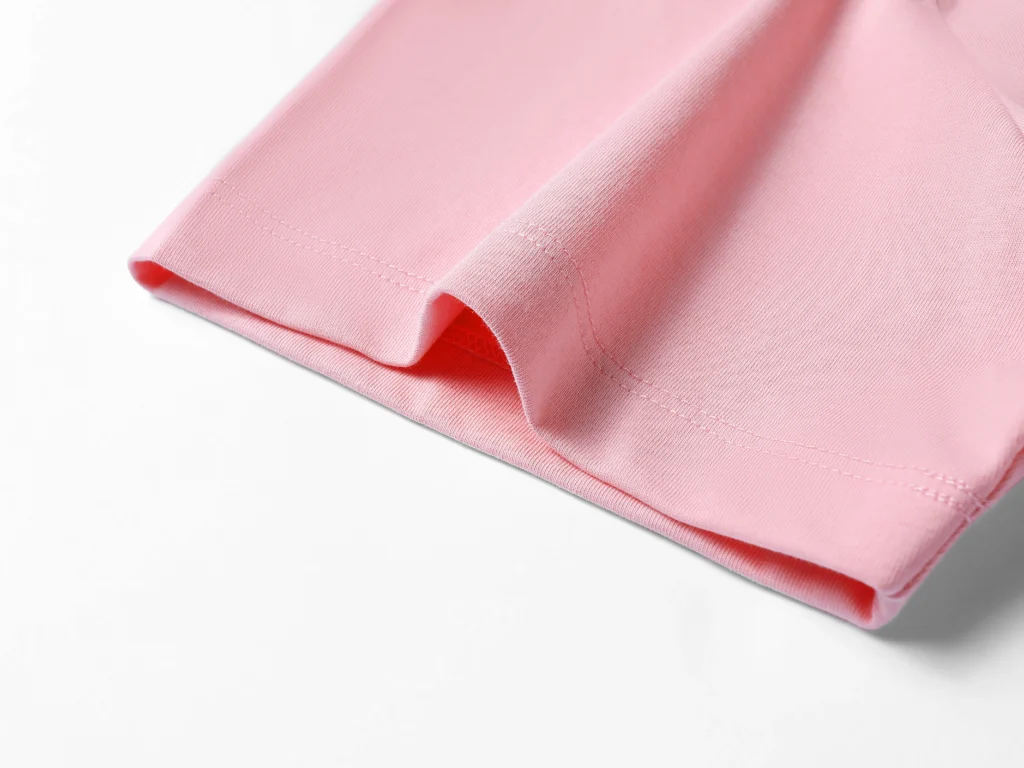
The components of a t-shirt do not move together, and the difference is what makes a garment look wrong after washing even when the body passes its check. The body may shorten while the sleeve holds its length, which makes the sleeve look long; the neckband may relax while the body contracts, which widens the opening and exposes the collar bones; and the hem may twist if the panels were cut off grain or the knit carries torque.
Measure each element on the washed garment rather than only on the body panel. Body length and chest width give the headline figures, sleeve length and cuff or sleeve opening show whether the garment has changed proportion, and neckband width shows whether the opening still fits. Where the neckband has its own stretch and recovery requirement, test it after the same cycle so that the shrinkage result and the band result describe the same garment rather than two separate specifications.
Cost, MOQ and Lead-Time Consequences
Consider the freight and storage implication as well, because shrinkage control changes the finished weight and sometimes the packed volume of the garment. A garment-washed programme adds handling and drying, and a resin-finished cloth can be marginally heavier at the same nominal weight. Those effects are small per unit but visible across a container, which is why a tolerance decision should be costed against the whole landed cost rather than against the fabric price alone.
Shrinkage control adds cost at the cloth or the garment, and the structure of that cost is worth understanding before the tolerance is set. Compacting adds a finishing stage to the cloth; resin finishing adds chemistry and a process; garment washing adds a per-piece operation plus drying and handling. A tolerance tighter than the market needs pays for a process the consumer will never notice, while a tolerance that is too loose pays for it later in exchanges.
Lead time is affected at the front of the schedule, because cloth that needs to relax before cutting adds days to the plan, and a garment-washed programme adds a separate production step with its own capacity. Programme size helps: t-shirt programmes can start from about 50 pieces per style, and ready-to-ship t-shirts are available from 1 piece, so a small run can be washed through the actual cycle and measured before the season order is committed.
Quality Checks That Catch Shrinkage Failures
Check the garment after washing, at the points the customer notices. Measure body length, chest width and sleeve length, then the neckband width, and compare every result against the approved tolerance rather than against the previous shipment. A body that has moved within tolerance while the neckband has relaxed twice as much is the common pattern, and it only appears when the components are measured separately.
The inspection list should include:
- Body length and chest width measured before and after the stated wash and dry cycle.
- Sleeve length and sleeve opening measured on the same schedule as the body.
- Neckband width checked after washing, since the opening is where relaxation shows first.
- Hem behaviour checked for twist and for level, which indicates off-grain cutting or a torque-prone knit.
- Cloth lot and finishing route recorded for the tested sample, so the result can be traced to the bulk.
- Care instructions confirmed against the tested cycle, using a recognised symbol system such as GINETEX.
Where a market requires fibre, care and origin information on the label, the wording and the tested cycle have to agree, and the requirements for that labelling are described in the care label compliance guide. Material compliance for the fabric and trims can be documented through the OEKO-TEX Standard 100 framework where the market requires it.
Repeat-Order Consistency
Shrinkage is where a repeat order most often fails the first order’s standard, because the cloth arrives with a different residual movement and the relaxation time before cutting varies with scheduling pressure. A programme that reproduces the measurement chart but not the process can still deliver a garment that moves differently, and the difference is invisible until the customer washes it.
Record four things for every order: the cloth lot, the finishing route, the resting time before cutting and the wash result. Keep a washed reference garment in each colourway, and re-test when the cloth source or the finishing route changes rather than assuming the previous result still applies. Where the programme runs a garment-washed look, keep the approved washed sample so that the appearance standard and the dimensional result are approved together rather than separately.
What to Put in the Tech Pack
The shrinkage block should state the cloth and its finishing route, the test cycle with temperature and drying method, the allowed change for each measurement point as a percentage and a centimetre figure, and the components that are measured separately. Add the reference material: the approved washed garment, the cloth lot recorded against the test and the tolerance stated with its method.
Two further lines close the loop. Record the relaxation time allowed between cloth arrival and cutting, because it is a process variable that changes the result, and record the neckband or rib recovery expectation after the same cycle, since openings relax while the body contracts. With those in place, a shrinkage claim becomes a tested result rather than a label statement, and the knowledge hub carries the supporting guides on fabric, construction and testing.
FAQ
How much shrinkage is normal for a cotton t-shirt?
The useful answer is the tolerance set for the programme rather than a general figure, because the result depends on the cloth, the finishing route and the wash cycle used. What matters is that the tolerance is written with a method, measured on the finished garment, and applied to the body, the sleeve and the neckband separately. A body that moves within tolerance while the neckband relaxes beyond it still represents a fit failure.
Does a pre-shrunk t-shirt still shrink?
It shrinks less, not never. Compacting and pre-shrinking remove most residual shrinkage from the cloth, but the garment still moves in the first wash and the neckband may relax more than the body. The remaining movement is what the tolerance covers. Test the finished garment through the cycle printed on the care label, and set the tolerance so that the shirt still matches its size chart after one full cycle at that temperature and drying method.
Why does the neckband lose shape when the body is fine?
Because the band and the body respond differently to water and heat. A rib band with limited elastane relaxes while the body contracts, so the opening grows as the garment shortens, and the result reads as a fit failure even though the body measurement passed. Measure the neckband separately, apply a recovery requirement with a test method, and confirm the result after the stated wash cycle rather than on a fresh sample.
Should shrinkage be tested on the fabric or the garment?
Both, at different stages. Fabric testing confirms the cloth behaves as specified before the order is cut, which is the lowest-cost point at which to catch a problem. Garment testing confirms the assembled t-shirt behaves as the customer will experience it, including the neckband, hem and sleeve openings. Where time allows only one, test the garment, because it is the state the customer receives and the state in which shape failures appear.
Setting shrinkage tolerances for a t-shirt programme?
Send the fabric, the colourways, the wash regime the shirt must survive and the tolerance you need, and LSLONG will confirm the finishing route, the test cycle and the measurement points, then wash-test a sample before the order is committed. Fabric sourcing, decoration and quality control are handled in-house in Shenzhen.